Facebook
 Google
 LinkedIn
https://lasma.eu/en/search/products
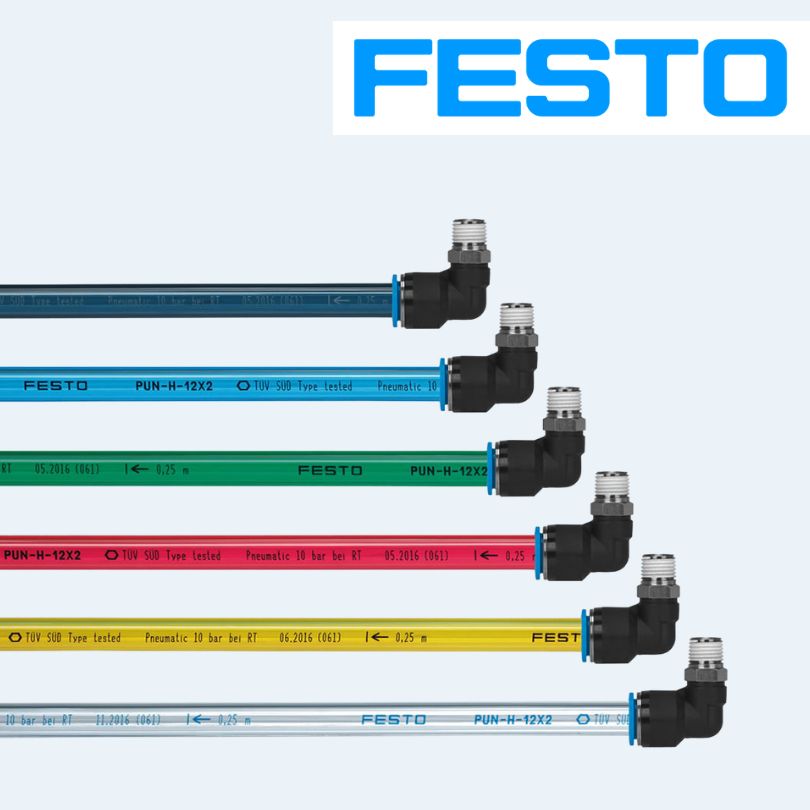
A pneumatic tube may seem like a simple part of a system, but air flow, connection tightness, and the operation of pneumatic components depend on it. An incorrectly selected material, diameter, or connector can cause pressure drop, air leaks, and unplanned equipment downtime.
The Festo range of pneumatic tubing includes solutions for standard automation tasks as well as for use in welding areas, humid environments, elevated temperatures, or chemically aggressive processes. The correct tube is determined not by a single parameter, but by a set of requirements.
The material determines the tube's flexibility, resistance to pressure and temperature, chemical resistance, and suitability for moving assemblies.
Material | Main properties | Typical application |
|---|---|---|
PU or polyurethane | Flexible, suitable for small bending radii, available in various colors | Control systems, compact assembly and moving assemblies |
PA or polyamide | Stiffer, mechanically durable and pressure-resistant | Fixed compressed air lines and longer tubing sections |
PE or polyethylene | Lightweight, economical and resistant to many chemicals | Standard pneumatic systems and cost-sensitive projects |
PTFE and PFA | High temperature and chemical resistance | Aggressive environments, intensive washing and specific technological processes |
This comparison is general. The exact working pressure, temperature range, bending radius and chemical resistance depend on the specific tube series, diameter and wall thickness. These parameters should always be checked in the technical data sheet.

Polyurethane tubes are often used to connect pneumatic control components. They are flexible, easy to install and suitable for places where available space is limited.
Different tube colors help clearly separate pneumatic lines. For example, different colors can be used to mark the cylinder extension and retraction connections. This simplifies commissioning, diagnostics and repair.
Depending on the version, PU tubes can be resistant to welding spatter, flame-retardant, electrically conductive, or suitable for conditions of elevated humidity and hydrolysis exposure.

Polyamide tubes are stiffer than PU tubes and better retain their shape. They are usually chosen for fixed compressed air lines, control cabinet connections and longer tubing sections.
Greater stiffness also means less flexibility. During installation, the minimum bending radius must be observed, because too sharp a bend can reduce the tube's internal cross-section and restrict air flow.
Polyethylene tubes are lightweight and economical. They can be used in standard industrial systems where there are no very high temperatures, intensive movement or heavy mechanical loads.
PE material has good resistance to many acids, alkalis and salt solutions, but chemical compatibility should always be checked taking into account the specific substance, its concentration and the working temperature.

PTFE and PFA tubes are used in processes that require high temperature or chemical resistance. They are suitable for aggressive cleaning, chemical exposure and special production environments.
For certain Festo tube series, the working temperature range may be approximately from –20 to +150 °C, but the exact limits depend on the version, diameter, working pressure and the connector used.
A tube that is too small restricts flow and causes pressure drop. As a result, the cylinder may move more slowly, the tool may not reach the required power, and the compressor may run longer than necessary.
When selecting the diameter, the following must be taken into account:
required air consumption;
tube length;
working pressure;
allowable pressure drop;
cylinder size and movement speed;
valve and connector flow capacity.
For example, if the cylinder speed must be increased, the required air flow increases. If the tube, valve or connector is too small, increasing the pressure at the start of the system will not always solve the problem.
In modern pneumatic systems, externally calibrated tubes are most commonly used. Their size is specified by the outer diameter, for example 4, 6, 8 or 10 mm. Internally calibrated tubes are more common in older equipment, so in modernization projects it is necessary to check which diameter was used to select the existing connections.
Many leaks are caused not by the tube itself, but by an incompatible tube and connector combination.
Not only the nominal diameter must match, but also:
the tube material;
the diameter tolerance;
the working pressure;
the temperature range;
the connector sealing material;
the conveyed medium.
During installation, the tube must be cut straight without damaging its edge, and inserted fully into the push-in connector. An angled cut, a crushed edge or incomplete insertion can cause leakage even if the nominal dimensions match.

Tubes with the same outer diameter can differ in wall thickness, flexibility, pressure resistance and allowable operating temperature. Therefore, comparing diameter alone is not enough.
The correct approach: check the full technical specification and ensure the tube is compatible with the operating conditions and connectors.
A bend that is too sharp can reduce the tube's internal cross-section, restrict air flow, or permanently deform the tube.
The correct approach: observe the minimum bending radius specified by the manufacturer or use a suitable angle connector.
Repeated bending and movement can cause material fatigue, cracking and premature tube failure.
The correct approach: choose a flexible tube designed for repeated dynamic loads for moving assemblies.
A standard tube can quickly deteriorate under welding spatter, UV radiation, moisture, elevated temperature or aggressive cleaning agents.
The correct approach: select the tube material and version intended for the specific operating environment conditions.
Pneumatic tubes should be inspected periodically along their entire length, with special attention to connection points and moving sections.
Possible damage is indicated by:
cracks and abrasions;
hardened or discolored material;
bent or deformed sections;
tube swelling;
slipping out of the connector;
audible air leakage;
unusual pressure drop.
It is safer to replace a damaged tube section than to make a temporary repair with materials not intended for pneumatic systems.
The selection of pneumatic tubing is determined by material, diameter, working pressure, temperature, movement intensity, ambient environment and compatibility with connectors. PU tubes are suitable for flexible installation, PA tubes for stable and mechanically durable lines, PE tubes for standard solutions, and PTFE and PFA tubes for environments with elevated temperature or chemically aggressive conditions.
A properly selected tube helps ensure the required air flow, reduce leaks and avoid unnecessary equipment downtime. The ZTF Lāsma team can help assess operating conditions and select mutually compatible Festo tubes and connectors.