 Facebook
 Google
 LinkedIn
https://lasma.eu/en/search/products

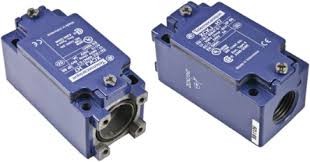
Limit switches are electromechanical position sensors used across conveyors, machine tools, cranes, presses, and guard interlocking systems. Engineers choose them for direct-contact detection without a separate sensor supply, high switching reliability, and availability in configurations from basic position feedback to SIL 2/PLd safety circuits. Telemecanique (Schneider Electric) XCK and OsiSense XC series are among the most widely specified in European industrial installations.
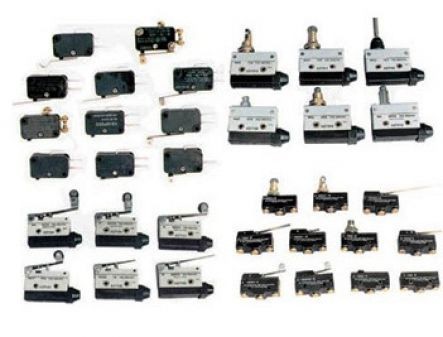
This category covers complete limit switch assemblies and their individual components. Standard and heavy-duty switch bodies (die-cast zinc or aluminum) handle cam-operated machinery, conveyor end-of-travel, crane hoists, and press ram detection. Miniature limit switches fit tight spaces in packaging and robotics. Safety limit switches with positive-opening contacts are used in guard door interlocking and safety-rated control circuits. Rope pull switches run along conveyor lines for emergency stop or belt misalignment detection.
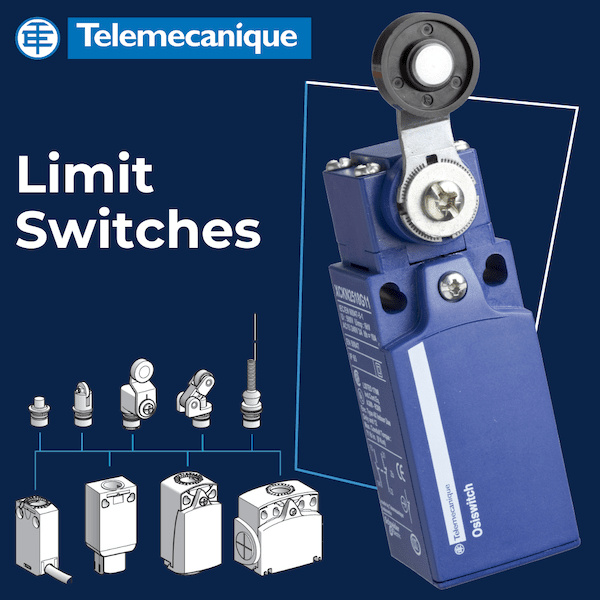
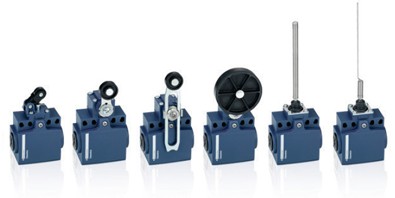
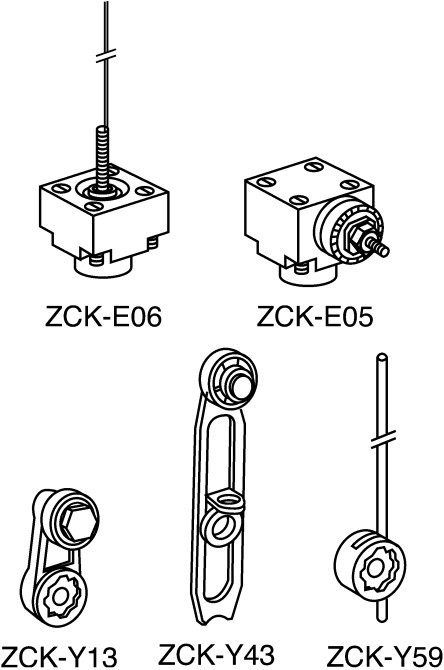
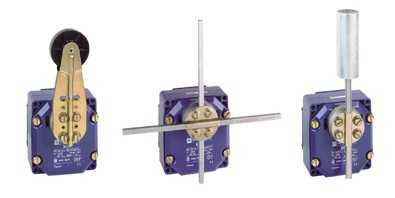
Actuator heads are typically sold separately or as part of a modular assembly: roller lever and adjustable roller lever heads suit cam/dog-operated machines; plunger heads handle direct linear push; whisker actuators detect light contact in packaging lines; fork actuators capture rods or cams between two tines.
Accessories include replacement contact blocks (NC, NO, SPDT, DPDT), conduit entry fittings (M20, PG13.5, ½" NPT), mounting brackets, actuator arm extensions, sealing plugs for unused ports, and cam/trip dogs mounted on the machine side.
| Type | Typical Application | Key Feature |
|---|---|---|
| Standard roller lever | Conveyors, machine tools | Spring-return, cam-operated |
| Heavy-duty metal body | Cranes, presses, hoists | High mechanical durability |
| Safety / positive-opening | Guard interlocks, safety gates | Forced contact separation |
| Miniature | Packaging, robotics | Compact form factor |
| Rope pull | Conveyor lines | Distributed emergency stop |
Positive-opening contacts are required in safety circuits such as guard door interlocks, where contact welding must be mechanically broken. Standard snap-action contacts are not acceptable for these applications.
Yes, on modular designs such as Telemecanique XCK series, contact blocks are field-replaceable independently of the switch body and actuator head, reducing maintenance cost and downtime.
IP69K is required for high-pressure, high-temperature washdown. IP67 covers temporary immersion but is not sufficient for direct high-pressure spray typical in food and beverage lines.
AC-15 applies to switching inductive AC loads such as contactors and solenoids; DC-13 applies to inductive DC loads. Always match the utilization category to your actual load type to ensure correct electrical life rating.