

 Facebook
 Google
 LinkedIn
https://lasma.eu/en/search/products

Encoders are position and motion feedback sensors used across industrial automation — from servo motor control and CNC machine tools to conveyor systems and robotics. Engineers select them to close the loop on position, speed, and direction feedback. The right encoder type depends on whether absolute position retention, resolution requirements, mounting constraints, and environmental conditions are the primary drivers.
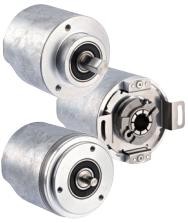
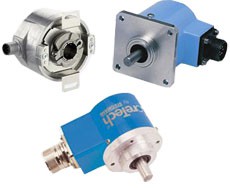
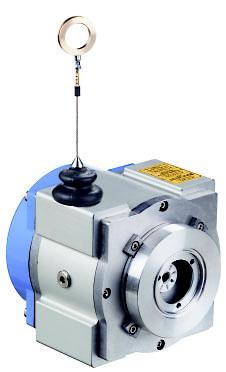
This category covers rotary and linear encoders used in closed-loop motion control, position feedback, and speed monitoring. Rotary encoders are the most common type, measuring shaft angle or rotation. Linear encoders measure displacement along a scale or track and are typical in CNC axes and precision gantry systems.
Incremental encoders output quadrature pulses (A/B + Z index) relative to a start position. They require homing on power-up and are widely used in conveyor drives, packaging machinery, and general motor speed feedback. Absolute encoders — single-turn or multi-turn — output a unique position code at all times and retain position through power loss, making them the standard choice for servo axes, robotics, and hoisting equipment.
Sensing technology also affects selection: optical encoders deliver high resolution but are sensitive to contamination; magnetic encoders are more robust in dirty, oily, or high-vibration environments. Inductive types suit harsh environments where magnetic interference is a concern.
| Type | Position on power loss | Homing required | Typical use |
|---|---|---|---|
| Incremental | Lost | Yes | Conveyors, general drives, speed feedback |
| Absolute single-turn | Retained | No | Servo axes, rotary tables |
| Absolute multi-turn | Retained | No | Robotics, hoists, multi-revolution axes |
| Linear encoder | Varies | Depends | CNC axes, precision stages |
Choose absolute when your application cannot tolerate a homing cycle after power loss — for example, servo axes, hoists, or robots. Incremental encoders are sufficient when homing on startup is acceptable.
Use HTL (10–30 V push-pull) for most PLC counter inputs. Use TTL/RS-422 differential for servo drives. Absolute encoders typically use SSI, BiSS-C, or fieldbus protocols such as EtherCAT or PROFINET.
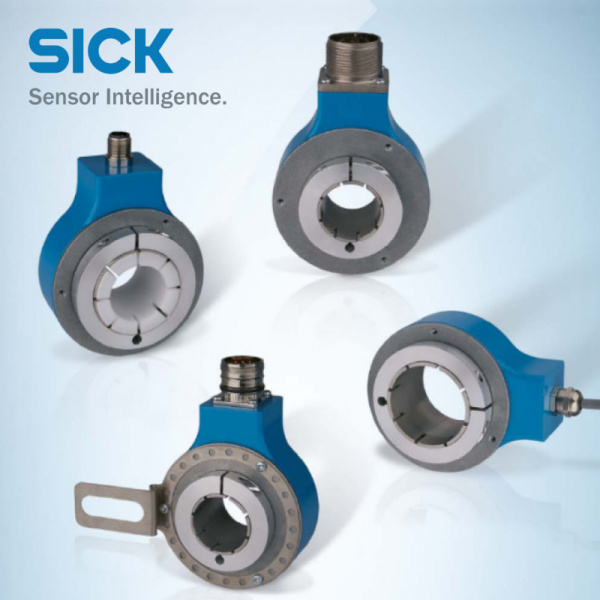
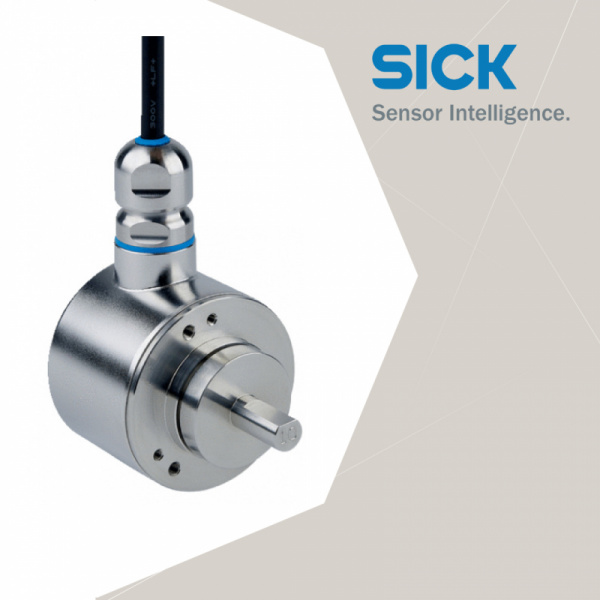
Hollow-shaft encoders mount directly onto the motor shaft without a coupling, saving space and alignment effort. Solid-shaft encoders require a flexible coupling but offer more flexibility in positioning.
IP69K is required for high-pressure washdown applications. IP67 covers occasional immersion. IP65 is sufficient for general industrial environments with dust and water spray.