

 Facebook
 Google
 LinkedIn
https://lasma.eu/en/search/products
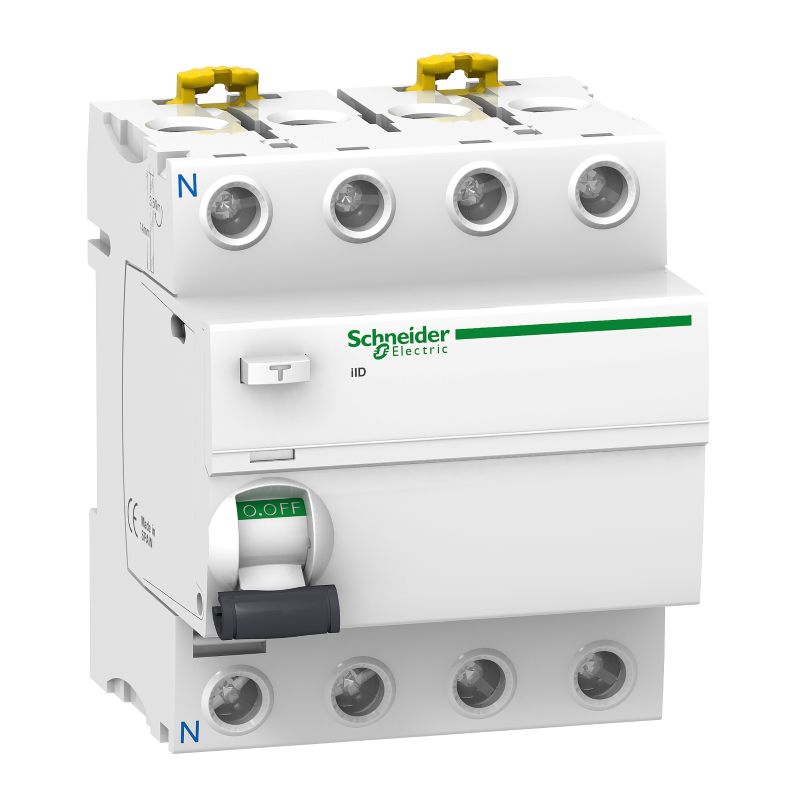
Residual current circuit breakers (RCCBs) protect against electric shock and fire by detecting even small earth leakage currents — through a person, deteriorated insulation, or a damaged appliance — and disconnecting the circuit within milliseconds. RCBOs combine residual current protection with overload and short-circuit protection in a single DIN rail module, saving panel space and giving each circuit independent fault isolation. We stock Schneider Electric Acti9 RCCBs and RCBOs — 2P and 4P; sensitivity from 10 to 300 mA; Type AC, A, B and selective variants for every application from residential distribution boards to industrial main panels. Engineering support available for project specification.
An RCCB continuously monitors the current balance between the live and neutral conductors. Under normal conditions, every ampere leaving through the live wire returns through the neutral — the two values are equal. When a fault occurs — a person contacts a live part, cable insulation fails, or moisture compromises an appliance — some current finds an alternative path to earth, creating an imbalance. When this imbalance reaches the device's trip threshold (typically 30 mA), the RCCB disconnects the circuit in milliseconds, before a potentially lethal shock can develop.
Unlike a miniature circuit breaker (MCB), an RCCB does not respond to overload or short-circuit current — it must always be used in series with an MCB, or replaced by an RCBO which combines both functions.
RCCB | RCBO | |
|---|---|---|
Earth leakage protection | ✓ | ✓ |
Overload protection | ✗ | ✓ |
Short-circuit protection | ✗ | ✓ |
Module width (typical) | 2–4 modules | 1–2 modules |
Best for | Protecting groups of circuits | Per-circuit protection; space saving |
Recommended | Extending existing installations | New build and refurbishment projects |
The type designation defines which categories of leakage current the device can detect:
Type AC — detects sinusoidal AC leakage only. Now obsolete; prohibited in new installations in most European countries
Type A — detects AC and pulsating DC leakage. The current standard for modern installations with inverter-driven appliances, heat pumps, washing machines and EV wallboxes on dedicated circuits
Type B — detects AC, pulsating DC and smooth DC leakage. Mandatory for EV charging stations, photovoltaic inverters, variable frequency drives and other power electronics that can produce smooth DC fault currents
Type S (selective) — incorporates a time delay to allow downstream devices to trip first; used in main distribution boards as part of a coordinated protection scheme
Sensitivity | Primary function | Typical application |
|---|---|---|
10 mA | Personal protection — high sensitivity | Medical locations, wet rooms, children's areas |
30 mA | Personal protection — standard | Residential, offices, socket outlet circuits |
100 mA | Fire prevention | Commercial lighting, fixed equipment |
300 mA | Fire prevention — main distribution | Industrial distribution boards, main incomer protection |
The Acti9 platform is Schneider Electric's modular protection range for residential, commercial and light industrial distribution boards. RCBOs combine the benefits of an MCB and an RCD in one compact device, saving installation time and space. The Acti9 iID (RCCB) and iDPN Vigi / iC60 Vigi (RCBO) families cover the full range of current ratings, sensitivity levels and types required for IEC 61008 and IEC 61009 compliant installations. Festo
Before specifying, confirm:
Number of poles — 2P for single-phase, 4P for three-phase circuits
Rated current — 16, 25, 40 or 63 A (higher ratings available)
Sensitivity — 10, 30, 100 or 300 mA depending on protection function
Type — Type A for standard loads; Type B for EV chargers, PV inverters and VFDs
Device function — standalone RCCB (paired with existing MCB) or RCBO (combined in one module)
Selectivity — whether a time-delayed upstream device is required for coordination
Not sure which configuration to specify? Our engineers can assist with device selection, cross-referencing, and panel coordination for your project.
Residential and commercial distribution boards — socket outlet and lighting circuit protection
Industrial control panels — earth leakage protection for motor and process circuits
EV charging installations — Type B RCCB or RCBO as required by IEC 60364-7-722
Photovoltaic and solar installations — Type B protection for inverter output circuits
Outdoor and wet area installations — garages, garden supply points, construction sites
Main distribution boards — selective 100/300 mA upstream protection for coordinated tripping
An RCCB provides earth leakage protection only — it will not trip on overload or short-circuit current and must be used in series with an MCB. An RCBO combines both functions in a single DIN rail module, providing per-circuit earth leakage, overload and short-circuit protection independently. RCBOs are the preferred choice for new installations where panel space and fault isolation per circuit are priorities.
Type A is the current standard for most modern installations and handles AC and pulsating DC leakage from inverter-driven appliances, heat pumps and washing machines. Type B is required wherever smooth DC fault currents may occur — EV charging stations, photovoltaic inverters, variable frequency drives and three-phase rectifier equipment. Type AC is no longer recommended for new installations in most European markets.
30 mA is the international standard for personal protection against electric shock — it is the maximum current that can be tolerated before serious physiological effects occur, and a compliant 30 mA device will disconnect within 300 ms at rated current. 300 mA devices are used for fire prevention at the main incomer level, where a lower sensitivity threshold would cause nuisance tripping from normal operational leakage across large installations.
No. An RCCB only measures the imbalance between live and neutral current — it does not respond to overload or short-circuit fault current. For complete protection, an RCCB must be used in combination with an MCB sized to the circuit, or the combination replaced by an RCBO which provides both functions in a single device.