

 Facebook
 Google
 LinkedIn
https://lasma.eu/en/search/products
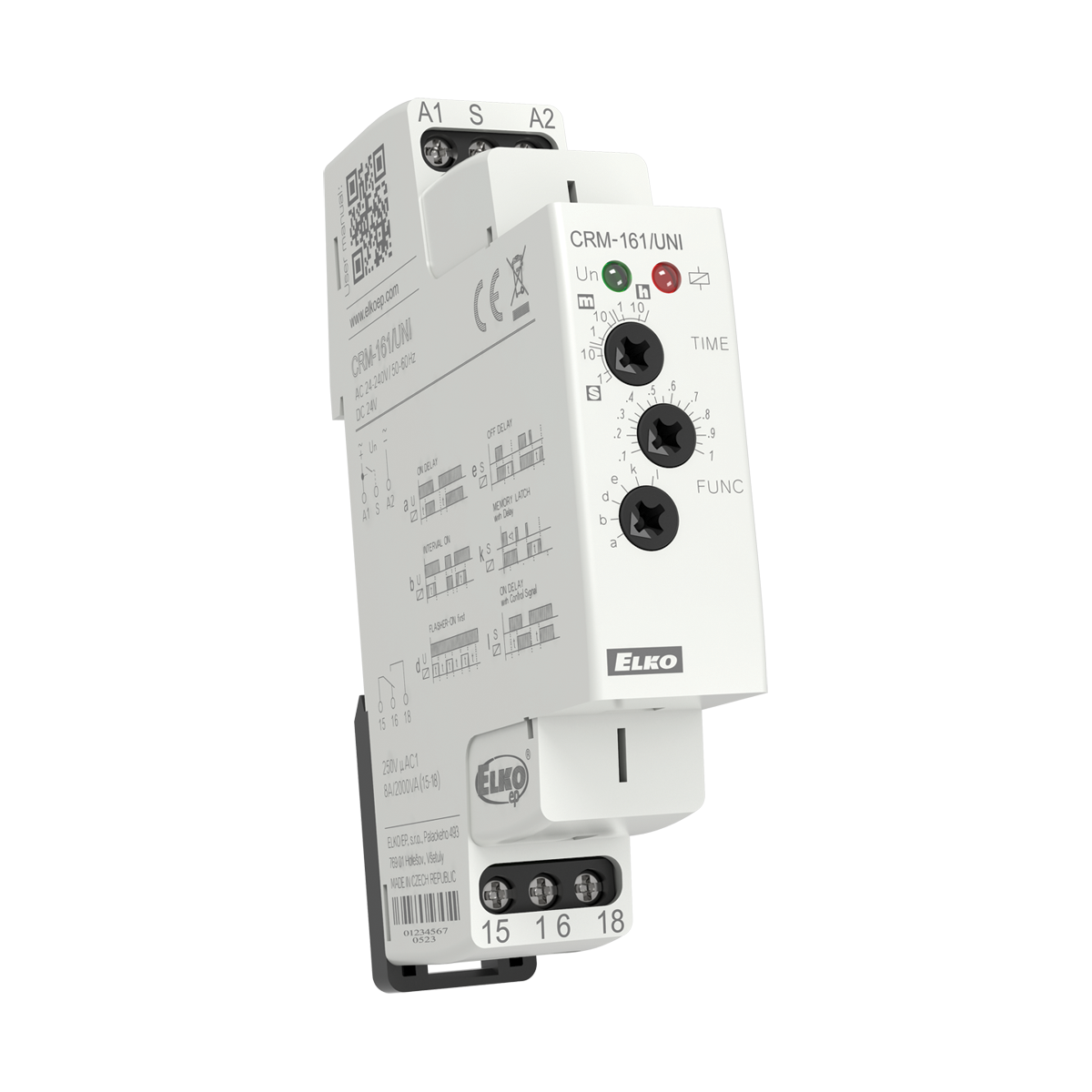
Time relays are used in industrial control panels, motor starters, HVAC systems, conveyor lines, and pump control circuits wherever a timed switching action is required. Engineers choose them to automate start/stop sequencing, prevent motor inrush damage, and reduce reliance on PLC logic for simple timing tasks. Available from Schneider Electric, Elko EP, and Emos — stocked in Riga.
Time relays control when an output switches ON or OFF relative to an input signal or power event. The category covers several distinct timing functions, each suited to different control tasks:
Mounting options include standard 17.5 mm or 22.5 mm DIN rail modules and plug-in socket types (8-pin or 11-pin octal base).
| Type | Typical use | Output active when |
|---|---|---|
| On-delay | Motor sequencing, conveyor start | After set time from energization |
| Off-delay | Fan run-on, brake release | Immediately; drops after set time from de-energization |
| One-shot | Dosing, welding, alarms | Fixed pulse duration per trigger |
| Repeat cycle | Pump cycles, lubrication | Alternating ON/OFF continuously |
| Multifunction | General panel use | Configurable via DIP switch or selector |
On-delay activates the output after a set time following energization. Off-delay keeps the output active for a set time after power is removed — used for fan run-on or brake release.
Yes. Multifunction timers use a DIP switch or rotary selector to set the timing mode, so one model covers multiple functions and reduces the number of different SKUs in a panel build.
Most star-delta applications use a transition time of 3–30 seconds. A range of 5–15 seconds covers the majority of standard industrial motors.
Use 24 VDC for PLC-based control panels and 230 VAC for legacy systems. Multi-voltage models (24–240 VAC/DC) are a practical choice when stocking for mixed installations.