 Facebook
 Google
 LinkedIn
https://lasma.eu/en/search/products

Pneumatic cylinders are the most widely used linear actuators in industrial automation, found in everything from automotive welding fixtures to food packaging lines. Engineers choose them for their straightforward force output, fast cycle times, and low maintenance requirements. Festo's cylinder range covers standard ISO sizes through to compact, guided, and rodless designs for demanding applications.
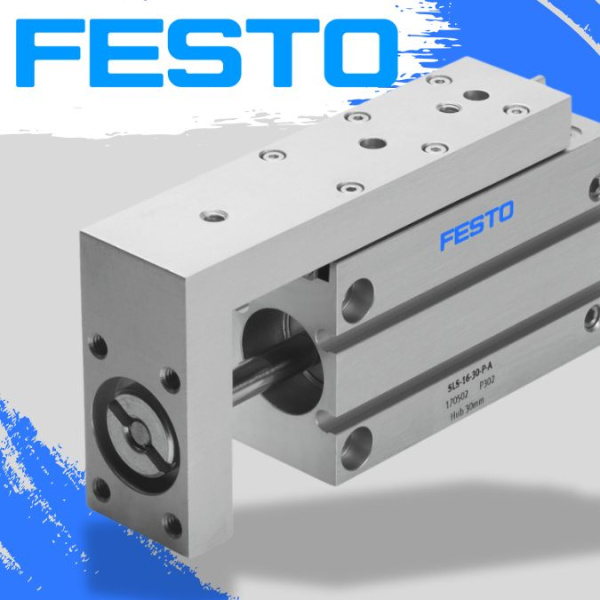
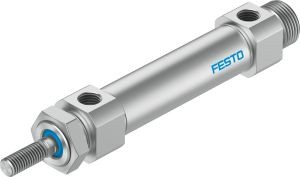
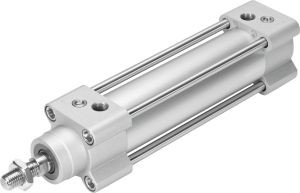
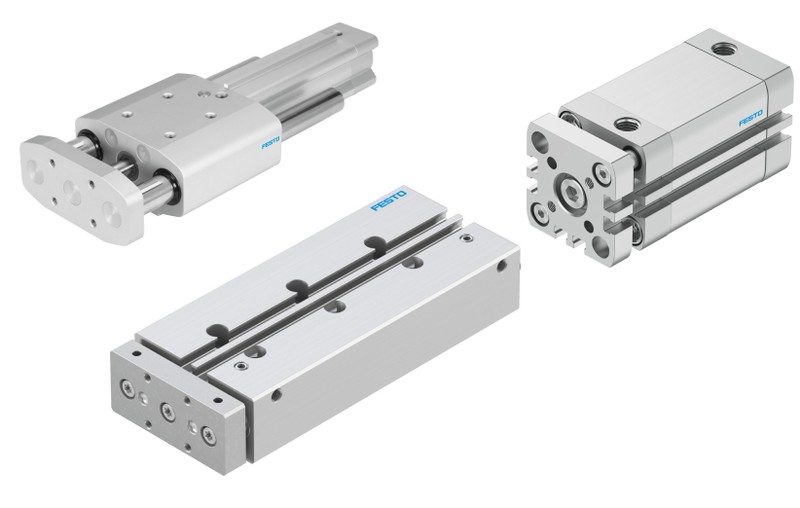
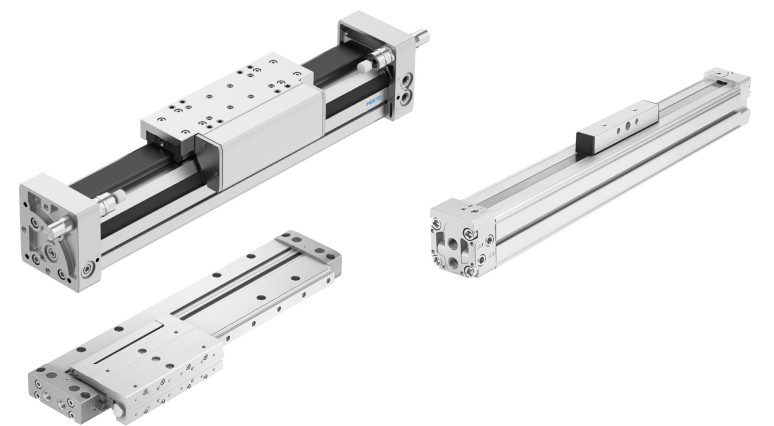
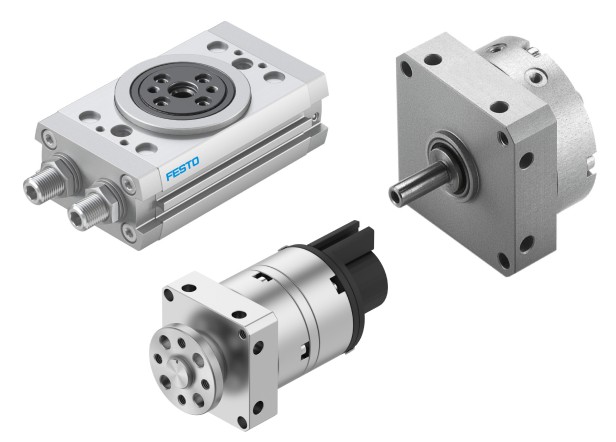
This category covers the full range of Festo pneumatic cylinders for industrial automation. The most common type is the double-acting cylinder (Festo DSBC series, ISO 15552), where compressed air drives both extension and retraction — the standard choice for most machine-building applications. Compact cylinders (Festo ADVU/AEVC, ISO 21287) suit space-constrained installations such as clamping and pressing. Guided cylinders (Festo DFM/DFSP) integrate linear guides directly into the unit, handling side loads and preventing rod rotation in pick-and-place and precision positioning tasks. Rodless cylinders (Festo DGC series) carry the load on an external carriage, making them practical for long strokes where a conventional rod would create an unacceptable footprint. Semi-rotary actuators (Festo DSM/DRVS) convert air pressure into rotary motion for indexing and clamping. Single-acting cylinders use a spring return and are selected where fail-safe retraction is required on air loss.
| Type | Typical Festo Series | Best For |
|---|---|---|
| Double-acting (ISO 15552) | DSBC | General machine building, long strokes |
| Compact (ISO 21287) | ADVU, AEVC | Clamping, pressing, tight spaces |
| Guided cylinder | DFM, DFSP | Side loads, pick-and-place, no rod rotation |
| Rodless | DGC | Long-stroke linear transport, space saving |
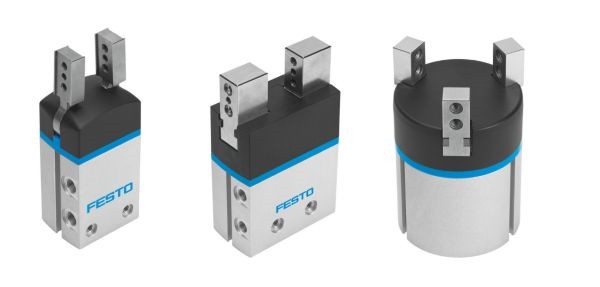
| Semi-rotary | DSM, DRVS | Indexing, turning, clamping fixtures |
| Single-acting | DSNU-S, ESNU | Fail-safe retraction, simple push applications |
Calculate required force from bore and supply pressure (F = π/4 × D² × P), then apply a 10–15% derating for friction. Festo's Positioning Drives software automates this calculation.
Use a guided cylinder like the Festo DFM when the load applies side forces to the rod or when rod rotation must be prevented — standard cylinders are not designed to handle lateral loads.
Yes. ISO 15552 defines mounting and port dimensions, so Festo DSBC cylinders are dimensionally interchangeable with ISO 15552-compliant cylinders from other manufacturers.
Specify IP65 or IP67 protection, stainless steel piston rod, EPDM or FKM seals, and a corrosion-resistant barrel — Festo offers dedicated stainless and hygienic design variants for these environments.