Facebook
 Google
 LinkedIn
https://lasma.eu/en/search/products

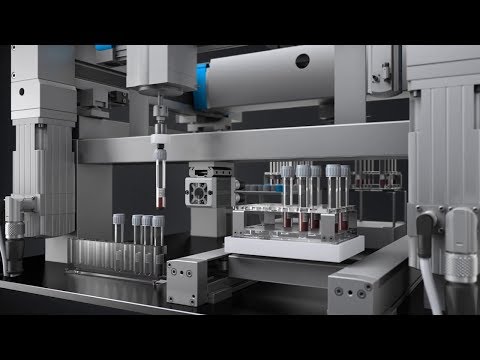
Automation in the biomedical, diagnostics, and laboratory environment is no longer just an additional advantage. It helps ensure higher process stability, lower error risk, and better repeatability, which are often critically important in laboratory work.
Festo, with its LifeTech solution portfolio, offers components and subsystems designed for liquid handling, pipetting, and dosing in laboratory automation and medical equipment. These solutions assist in developing compact, precise, and integrable systems where controlled liquid movement and dosing are required.
The Festo LifeTech portfolio is based on experience in several interconnected fields:
In practice, this means that manufacturers and system integrators can create compatible solutions from components designed to operate within a unified system. This is essential in places that simultaneously require accuracy, sterility, compact design, and process reliability.
Laboratory automation typically involves multiple tasks:
In such processes, not only mechanical movement is important but also stable pressure or vacuum control, precise liquid transfer, and the ability to customize the system for a specific application.
It is exactly here that Festo LifeTech components serve as fundamental nodes from which both simpler and more complex laboratory platforms can be built.
 In many liquid handling systems, the central element is a compact pressure and vacuum supply unit. The PGVA series provides controlled air supply for pipetting and dosing tasks, even without an external compressed air source.
This is practical in cases where the following are important:
| Parameter | PGVA-1-P-D30-Q4-A | PGVA-2-P1V1-Q4-A |
|---|---|---|
| Part Number | 8165129 | 8163214 |
| Standard Flow | ~1.0 L/min | ~1.2 L/min |
| Max Vacuum | –0.045 MPa | –0.062 MPa |
| Max Pressure | 0.045 MPa | 0.08 MPa |
| Dimensions (W × L × H) | 210 × 208 × 76 mm | 169 × 208 × 55 mm |
| Power Consumption | 19 W | 11 W |
| Supply Voltage | 24 V DC | 24 V DC |
| Communication | Modbus TCP | not specified |
| Filtration Grade | 0.01 µm | 0.01 µm |
| Configuration Support | CODESYS V3, Python scripts | Python scripts |
| Protection Class | IP20 | IP20 |
| Noise Level | 55 dB(A) | 55 dB(A) |
| Weight | 3.2 kg | ~1.8 kg |
| Certifications | CE, RCM, UKCA, RoHS | CE, RCM, UKCA, RoHS |

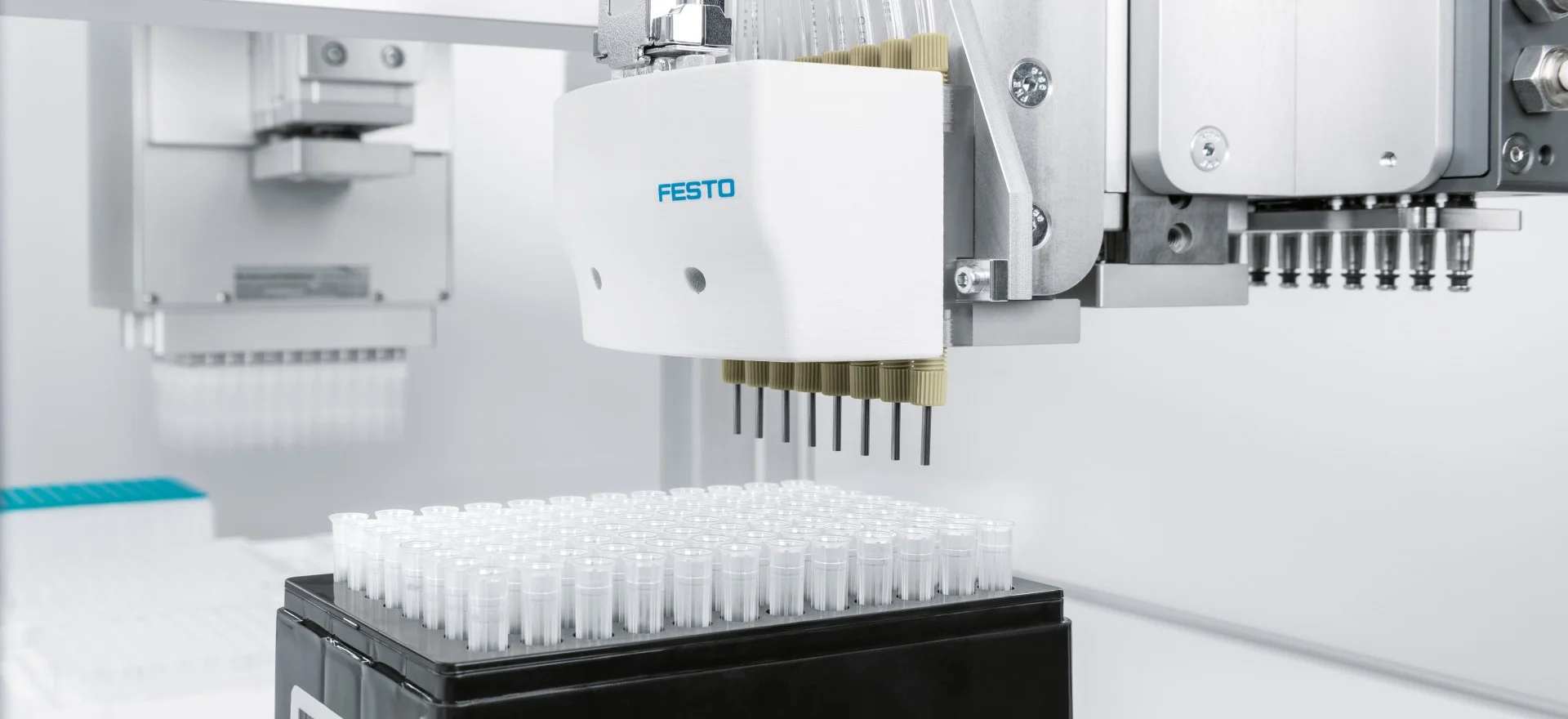
In the pipetting process, the most important factor is the ability to precisely aspirate, transfer, and dispense liquid while reducing the risk of contamination and cross-contamination.
The pipetting head is a liquid handling module capable of working with highly precise doses in the range of 5 to 10,000 µl.
An important advantage is the ability to use replaceable pipette heads, which help to:
This configuration is suitable for laboratory processes requiring safe and precise liquid transfer.
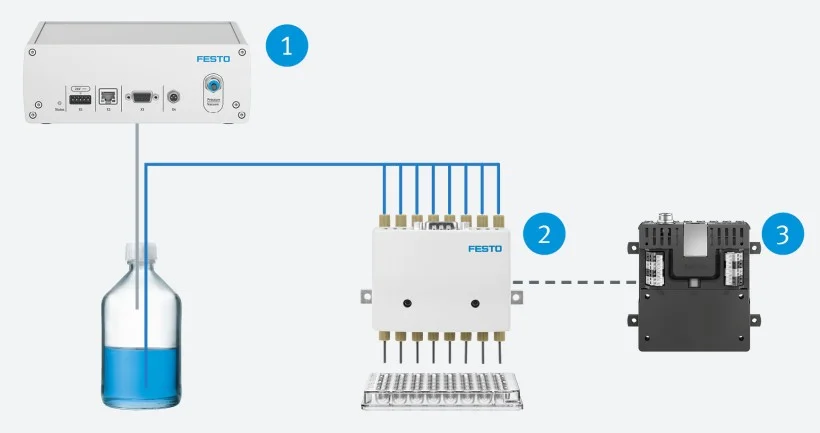
When the primary task is fast and precise delivery of reagent or other liquid at one or more points, dosing heads and valve control take priority.
The dosing head is designed for controlled liquid delivery, where the following are important:
 |  | |
|---|---|---|
| Parameter | VTOE dosing head | VTOI dosing head / distributor |
| Channels / valves | 1 or 8 independently controllable valves | 1 valve with 8 outlets |
| Output pitch | 9 mm | 9 mm |
| Minimum dosing volume | ~1 µL | ~1 µL |
| Dosing accuracy | 5 µL | ≤ 5% tip-to-tip CV; ≤ 3% intra-run CV |
| Valve function | 2/2, NC, monostable | 2/2, NC, monostable |
| Internal volume | ~113 µL | ~167 µL |
| Dosing needle | 0.32 mm, 0.6 mm, 1.0 mm variants | 0.3 mm / 30 mm |
| Operating pressure | up to ~0.5 bar | –0.2 to 0.65 bar |
| Connection | UNF 1/4-28 or tube | UNF 1/4-28 |
| Power supply | 24 V DC | 24 V DC |
| Valve frequency | up to ~4 Hz | ~4 Hz |
| Sealing | elastic | elastic |
| Materials in contact with medium | PPS, polycarbonate or PEEK, stainless steel | PEI, PPS, FKM, ETFE, stainless steel |
| Protection class | IP30 | IP30 |
| Typical application | flexible individual channel control | multi-channel dosing with one valve |
 VAEM is a valve control module intended for precise 2/2 and 3/2 valve control in microdosing systems for pharmaceutical, diagnostic, and laboratory applications.
The module can control up to 8 valves, making it suitable for multi-channel dosing solutions.
| Category | Value |
|---|---|
| Dimensions (D × W × H) | 92 × 100 × 28 mm |
| Protection Degree | IP20 |
| Nominal Operating Voltage | 24 V DC |
| Permissible Voltage Fluctuations | ± 10 % |
| Load Voltage Range | 8 … 24 V DC |
| Switch-On Level | 14 V … 24 V |
| Internal Current Consumption | 36 mA |
| Max Number of Outputs | 8 |
| Switch-On Current per Output | 20 mA … 1000 mA |
| Hold Current per Output | 20 mA … 400 mA |
| Total Switch-On Current | ≤ 4 A |
| Total Hold Current | ≤ 1.8 A |
| Switch-On Time | ≤ 100 ms |
| Time Resolution | 0.2 ms |
| Protection Against Polarity Reversal | For supply voltage |
| Diagnostics | LED (Error, Run) + bus diagnostics (wire break, short-circuit/overload, parameter error, low voltage) |
| Communication Interface | RS-232 (ASCII), 9.6–115.2 kBd, without galvanic isolation |
| Ethernet Interface | RJ45, 10/100 Mbit/s, Modbus® TCP |
| Communication Connector | M8×1, A-coded (EN 61076-2-104), 4 pins |
| Output Connection | 2× terminal block, spring type, 0.08…0.5 mm², 8 outputs |
| Mounting | With mounting holes |
| Compliance | CE (EMC, Low Voltage Directive), UKCA, RoHS |

In addition to dosing heads, it is possible to build solutions with individual dosing valves.
Typical configuration:


This approach is useful when greater flexibility in system configuration or individual control of specific channels is required.
Before selecting laboratory automation components, it is advisable to check several practical points:
If it is not checked which materials the liquid will come into contact with, chemical reactions, leaks, or shorter component service life may occur.
Not all processes require the same dosing accuracy. If the requirements are not clearly defined, either an overly complex or insufficiently precise solution may be chosen.
It is important to verify power supply voltage, communication interfaces, mounting dimensions, and control logic in time. This helps avoid unplanned changes late in the project.
If you need to assess which solution best fits your laboratory or equipment project, the ZTF Lāsma team will help you find the most suitable option.