Facebook
 Google
 LinkedIn
https://lasma.eu/en/search/products
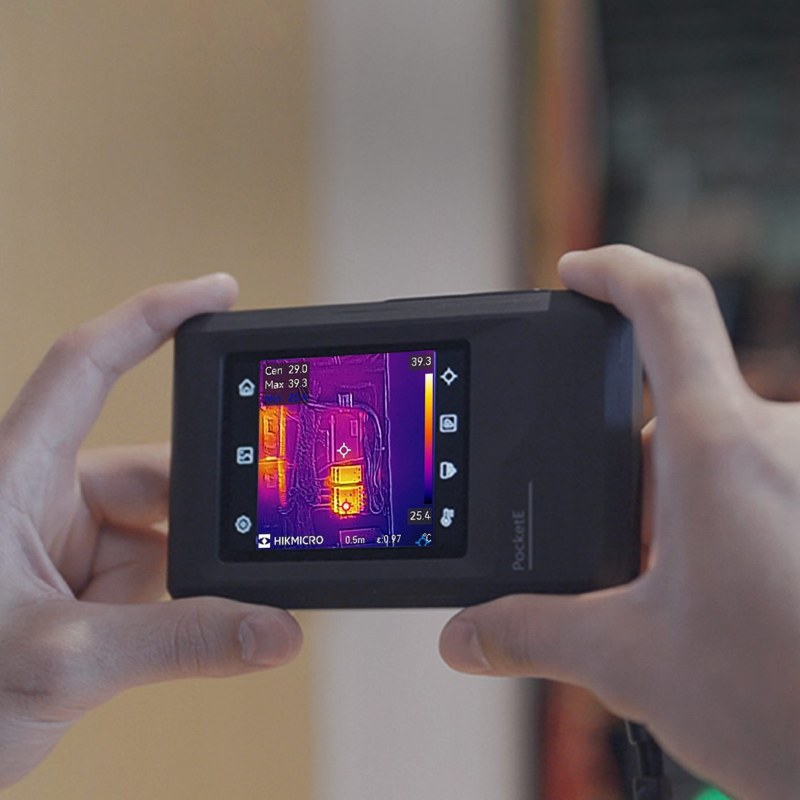
Portable thermal cameras reveal differences in apparent surface temperature for inspection and troubleshooting. This category includes standalone HIKMICRO handheld cameras and compact thermal attachments for compatible mobile devices. Compare detector resolution, temperature range, field of view, focusing, measurement tools and device compatibility when choosing a model.
Portable thermal cameras are inspection devices that detect infrared radiation emitted by surfaces and convert it into thermal images. These images show differences in apparent surface temperature, helping users locate areas that are warmer or cooler than their surroundings.
Unlike conventional cameras, which capture visible light, thermal cameras can reveal temperature patterns that are not visible to the human eye. They are used for inspecting electrical installations, mechanical equipment, heating and ventilation systems, buildings and other objects where temperature differences can provide useful diagnostic information.
Thermal imaging is a non-contact measurement method, allowing surfaces to be observed without physically touching them. However, identifying a temperature difference does not automatically establish the cause of a problem. The results must be interpreted in relation to the equipment, operating conditions and inspection task.
The HIKMICRO products in this category include several different device formats.
Standalone handheld thermal cameras
These devices combine an infrared detector, display and controls in a single portable unit. They can be operated without a smartphone or tablet.
The HIKMICRO Eco, Eco-V, PocketE and B-series models are examples of standalone thermal cameras. Depending on the model, they offer different display formats, imaging modes and measurement functions.
Smartphone-connected thermal cameras
Compact thermal imaging attachments connect to compatible smartphones or tablets and use the mobile device to display and analyse thermal images.
The HIKMICRO Mini series includes this type of camera. Individual models differ in thermal resolution, focusing options and supported mobile devices. Compatibility should always be confirmed for the specific camera and smartphone or tablet.
Portable thermal cameras can support inspection and troubleshooting in several fields.
Electrical inspection: Observing unusual heating in electrical panels, connections and components under appropriate operating conditions.
Mechanical maintenance: Examining temperature patterns in motors, bearings and other machinery that may indicate operating differences requiring further investigation.
Building inspection: Identifying temperature variations associated with insulation irregularities, air leakage or possible moisture-related problems.
Heating, ventilation and air conditioning (HVAC): Examining temperature distribution in heating and cooling systems.
Automotive inspection: Observing thermal patterns in vehicle components during maintenance and troubleshooting.
Thermal imaging provides supplementary diagnostic information. Additional inspection or testing may be required to determine the cause of an observed temperature difference.
Several technical characteristics influence how a thermal camera can be used.
Thermal resolution
Thermal resolution indicates the number of detector pixels used to produce the infrared image. Higher native detector resolution can provide more spatial detail, particularly when inspecting small components or objects at a distance.
Some HIKMICRO models also include SuperIR image enhancement. Enhanced image resolution should not be confused with the native resolution of the infrared detector.
Thermal sensitivity (NETD)
Noise Equivalent Temperature Difference (NETD) describes the camera's ability to distinguish small temperature differences under specified conditions. It is usually expressed in millikelvin (mK). A lower NETD value generally indicates greater sensitivity to subtle temperature differences.
Temperature measurement range
This specification identifies the temperatures that a camera is designed to measure. The required range depends on the application and the expected temperatures of the inspected surfaces.
Field of view and focusing
The field of view determines how much of a scene the camera captures at a given distance. A wider field of view can help when inspecting large surfaces or working in confined areas.
Some cameras use fixed-focus optics, while others provide manual focusing for adjusting image sharpness at different inspection distances.
Image modes and measurement tools
Depending on the model, thermal cameras may provide temperature markers, different colour palettes, visible-light images, image fusion or functions for recording and analysing inspection results.
These capabilities should be verified individually rather than assumed to be available on every model.
Start by identifying what needs to be inspected, the expected temperature range and the typical distance between the camera and the target.
For general inspection tasks, portability, ease of operation and a suitable field of view may be important. Applications involving small components or distant objects may place greater emphasis on detector resolution, focusing and spatial detail.
The device format is another consideration. A standalone camera provides an integrated inspection tool, while a smartphone attachment depends on a compatible mobile device.
Finally, consider how the measurement results will be used. If the task involves documenting inspection findings, check the available image storage, analysis and reporting functions.
For reliable interpretation, users should also understand factors affecting infrared temperature measurements, including surface emissivity, reflected radiation and environmental conditions.
The appropriate combination of characteristics depends on the task, so individual product datasheets should be consulted before selecting a camera.
A standalone thermal camera has its own display and controls and can operate independently. A smartphone thermal camera is a compact attachment that connects to a compatible smartphone or tablet and uses its screen and software for thermal imaging. Both detect infrared radiation, but their operating formats and available functions differ.
Thermal resolution determines the number of detector pixels available to represent temperature patterns. Higher resolution can help distinguish smaller details. Thermal sensitivity, expressed as NETD, indicates how small a temperature difference the camera can detect under specified conditions. Both are relevant when comparing cameras, but neither alone determines overall measurement accuracy.
Thermal cameras can reveal unusual surface temperature patterns that may be associated with overheated electrical components, insulation irregularities or other conditions. However, a thermal image alone does not confirm the cause. Findings must be assessed in the context of operating conditions and, where necessary, supported by additional inspection or measurements.