 Facebook
 Google
 LinkedIn
https://lasma.eu/en/search/products
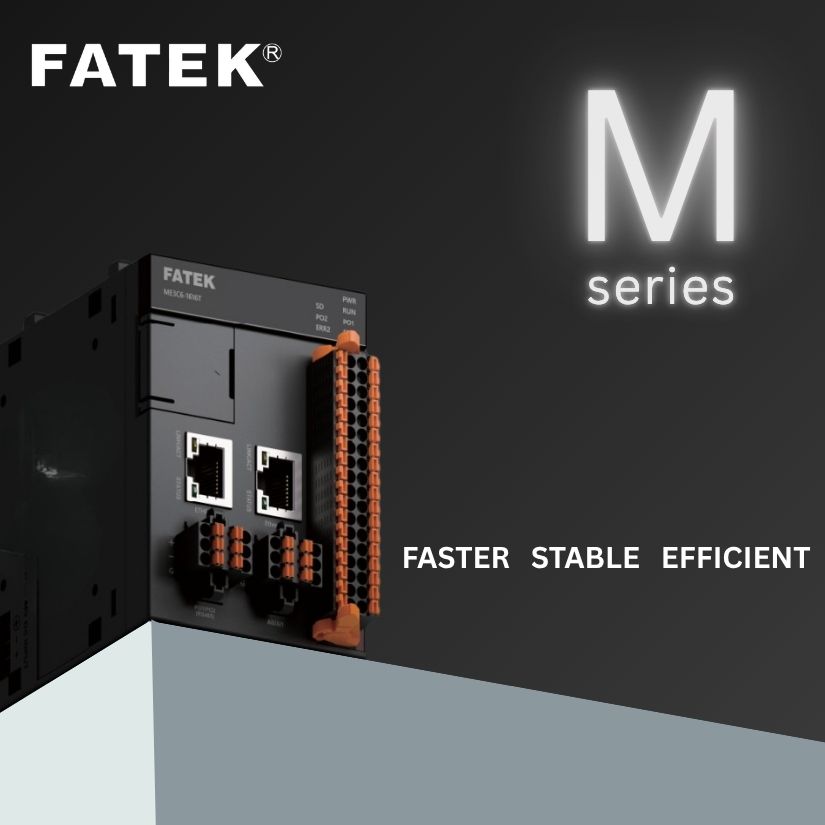
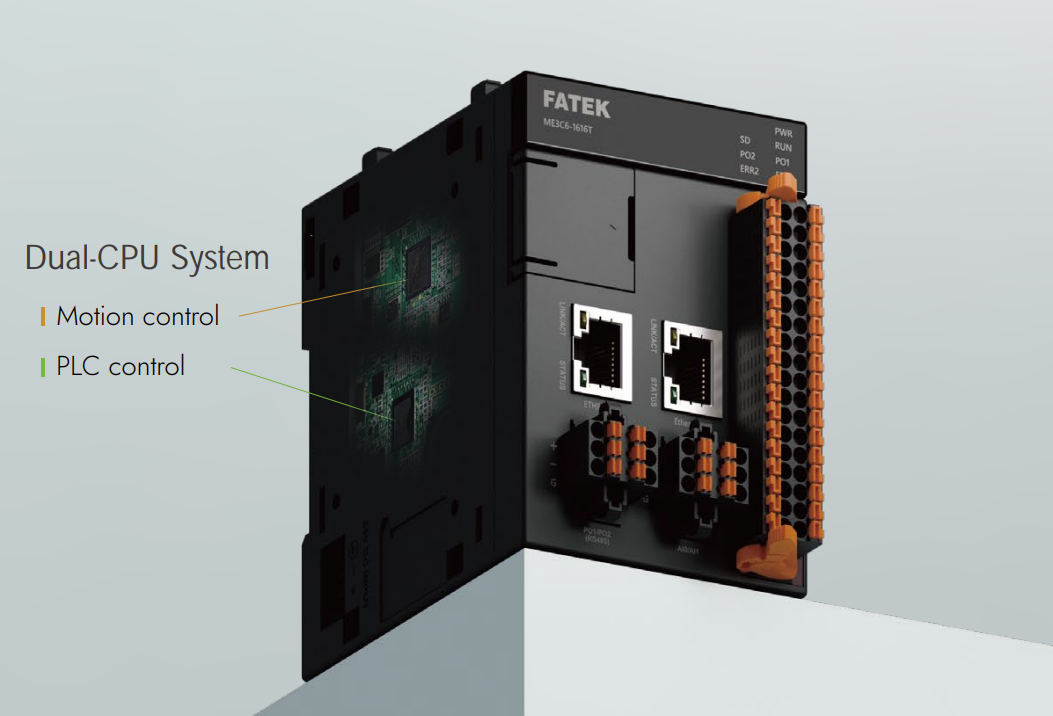
In industrial automation, the demand for faster data processing and precise synchronization continues to grow rapidly. The FATEK M series is a fully modernized, modular PLC platform developed to efficiently address highly complex industrial control and motion control (motion control) applications. New-generation control technology and a unique architecture help engineers and manufacturers optimize machine operation, providing a clear and easily comparable selection of M series processor families and expansion options.
FATEK Automation Corporation has established a reputation as a reliable and stable PLC manufacturer for more than thirty years. The new platform represents the company's next-generation technological leap. In practice, this means that the same platform can cover both compact OEM machines and multi-axis systems with synchronized motion control:
Ultra-fast data processing: Thanks to FATEK's unique HARD PLC architecture, LD (Ladder Diagram) instruction execution speed reaches up to 0,8 ns with ultra-low interrupt latency. HARD PLC means hardware logic-based I/O control, which eliminates delays caused by the operating system (OS) or application layer.
Built-in I/O points: All M series base CPU models have 16 digital inputs (DI) and 16 digital outputs (DO) already installed as standard on the controller body.
Advanced motion control: Depending on the selected model, the platform provides the EtherCAT real-time industrial network, interpolation (linear, circular and helical), electronic cam (E-CAM) and synchronized axis control for up to 24 axes.
Modern connectivity and IoT: The base specification includes 1x or 2x Ethernet ports, 2x RS-485 ports and a modern USB Type-C port for convenient programming. For Industrial IoT (IIoT) needs, MQTT and Modbus TCP protocol support is integrated for remote monitoring and data transfer to clouds or SCADA systems.
Scalability and capacity: The system can scale up to 2048 digital I/O (DIO) points, 256 analog I/O (AIO) points and supports connection of up to 64 expansion modules.

Our experience shows that in modernization or retrofit projects and in new machine building, flexibility is the primary requirement. The FATEK M series is suitable for situations where more than classic relay logic is required. Typical application industries and machines include packaging and labeling machines, synchronous material feed units, textile machines, multi-axis cutting and dosing solutions, smart conveyors, as well as test benches.
It also plays an important role in energy efficiency and condition monitoring (condition monitoring) systems, where the PLC not only controls the process but also simultaneously collects and transfers data to higher-level control structures.
To precisely select the controller best suited to the technical requirements, FATEK has divided the M series into five specialized categories:
Series | Category | Main application | Built-in I/O (DI / DO / AI) | EtherCAT support | Motion control specifics | Max. DIO / AIO amount | Expansion type |
|---|---|---|---|---|---|---|---|
MQ | Compact | Compact OEM machines and positioning tasks | 16 DI / 16 DO / No AI | Shared Eth/EC port | Up to 20 axes; 4-8 pulse output axes (200 kHz) | 512 DIO / 128 AIO | Plug-in plates + local expansion |
MA | Extended | Standard industrial automation systems | 16 DI / 16 DO / No AI | Shared Eth/EC port | Up to 24 axes; up to 8 pulse output axes (200 kHz) | 2048 DIO / 256 AIO | Up to 64 local modules |
MU | General motion control | More compact multi-axis machines | 16 DI / 16 DO / 2 AI | Yes (separate port) | Up to 18 axes; 4 EtherCAT real axes; 2 pulse axes | 512 DIO / 128 AIO | Local modules (advanced expansion not supported) |
MS | General motion control | Packaging and synchronized motion systems | 16 DI / 16 DO / 2 AI | Yes (separate port) | Up to 24 axes; 12 EtherCAT real axes; E-CAM up to 3 axes | 2048 DIO / 256 AIO | Up to 64 local modules |
ME | Advanced motion control | High-end and complex motion systems | 16 DI / 16 DO / 2 AI | Yes (separate port) | Up to 24 axes; 16 EtherCAT real axes; E-CAM up to 16 axes; helical interpolation | 2048 DIO / 256 AIO | Up to 64 local modules |
Most software-based controllers available on the market, or Soft PLC solutions, are based on computer-like architectures where the control logic is executed on top of a general-purpose operating system. When system load increases - for example, when intensive data exchange with operator panels (HMI), network request handling and complex calculations occur simultaneously - unexpected delays and system instability may appear.
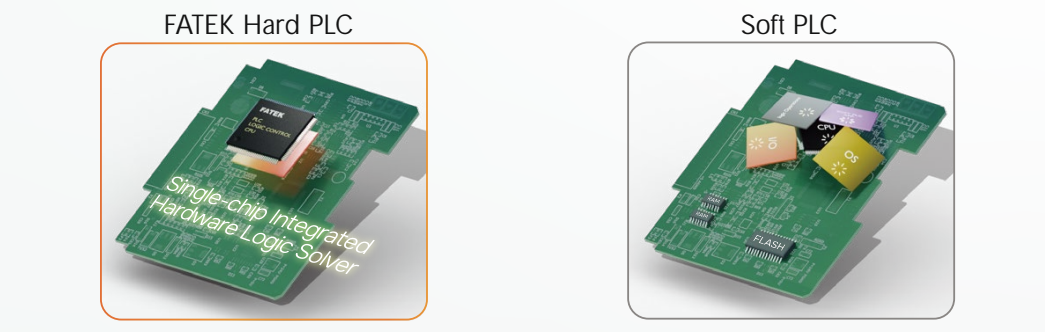
In contrast, the hardware-level architecture of FATEK HARD PLC integrates the entire control core directly into a single specialized chip. As a result, the system provides:
Stable cycle time without fluctuations: Timing deviations (phase jitter or cycle unevenness) are practically equal to 0%, which guarantees strictly defined and predictable command execution regardless of communication load.
Lower heat generation: Power consumption and heat generation are reduced by up to 58% compared with software-based controllers. This makes it possible to ensure stable fanless enclosure operation in low-temperature mode and significantly extends the service life of electronic components.
Instant readiness for operation: The controller powers on and starts program execution immediately after power supply is applied, without waiting for the operating system to load.
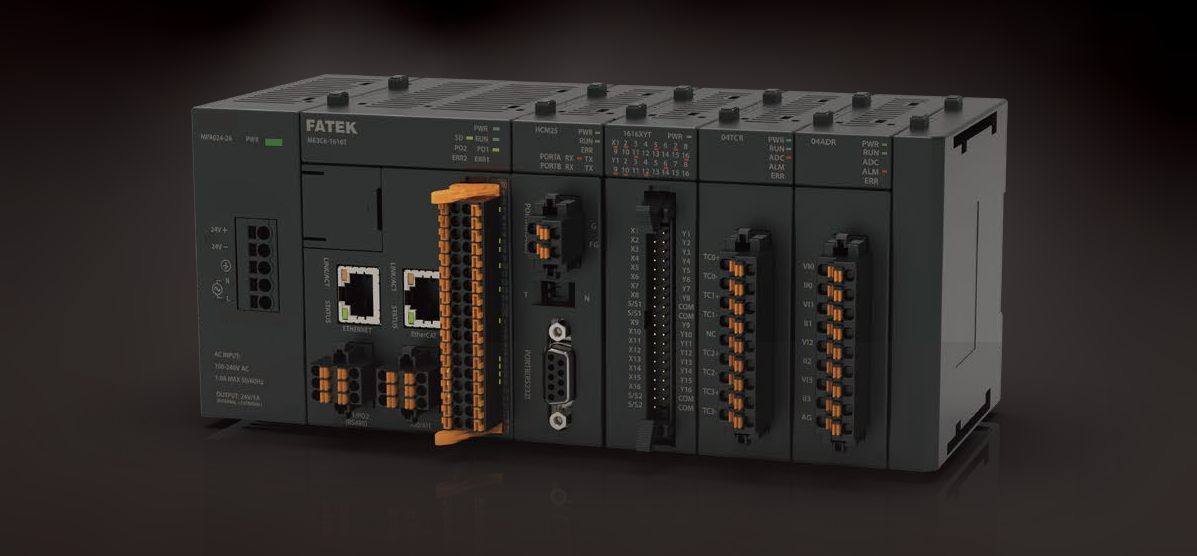
The strong point of the M series is its scalability using the high-speed FATEK Hyperbus bus. Each expansion module has its own independent processor (MCU) built in, which performs local tasks such as signal scaling (scaling) or temperature PID auto-tuning, thereby relieving the central processor.
The most popular and most frequently used types of M series modules are listed below:
Category | Model | Specification and signal types | Connection type |
|---|---|---|---|
Digital I/O | M16X | 16-point digital input (24 VDC) | Convenient Push-in terminal blocks |
M16YT / M16YJ | 16-point transistor output (SINK NPN or SOURCE PNP) | Convenient Push-in terminal blocks | |
M16YR | 16-point relay output | Convenient Push-in terminal blocks | |
Analog I/O | M04AD | 4-channel voltage/current input (14-bit resolution) | Push-in terminal blocks |
M04DA | 4-channel voltage/current output (14-bit resolution) | Push-in terminal blocks | |
Temperature & Scales | M04TC / M04TD | 4-channel thermocouple (TC) or RTD (Pt100/Pt1000) input | Push-in terminal blocks |
M02LCR | 2-channel high-precision load cell module | Push-in terminal blocks | |
Communication | MHCM25 / MHCM55 | Additional high-speed serial ports (RS-232, RS-485) | Modular interface sockets |
Bus expansion | MRPWE-AC | Repeater module for local system expansion | Allows connection of additional I/O module rows |
To ensure that the selected FATEK M series controller fully meets your needs, we recommend checking the following before confirming the specification:
Motion requirements: Will step/servo motors with pulse control (PTO) be used in the project, or is real-time EtherCAT industrial network synchronization required?
Number of axes: How many physical and how many virtual axes will need to be controlled? Is system expansion planned in the future?
Built-in analog nodes: Are analog inputs needed directly on the CPU (available in the MU, MS, ME families), or is it more rational to use the MA/MQ series and add a separate analog signal module?
Cabinet layout: Will all required expansion modules fit in one DIN rail row, or should MRGH/MRGT modules be provided for splitting the system into multiple rows?
Signal specifics: Do the field sensors and actuators require an NPN (SINK) or PNP (SOURCE) logic connection?
Relying only on the family name: The assumption that all MA or MQ series processors are identical is misleading. Certain models in these series have a shared Ethernet/EtherCAT port, while EtherCAT functionality is not intended at all on others. Selection must always be made based on the specific model code.
Assuming the presence of analog I/O: the compact MQ and extended MA series do not have built-in analog inputs - if 4-20 mA or 0-10 V signals must be processed without additional modules, MU, MS or ME controllers should be selected.
Ignoring expansion module compatibility: So-called high-speed or advanced expansion modules and module block rows are not supported equally across all CPU models (for example, the compact MU series has limitations compared with MS and ME).
The FATEK M series control platform successfully combines the unified programming environment UperLogic (which supports LD and ST languages) with high-end hardware performance. This makes it possible to optimize costs and control both small local machines and complex Industry 4.0 nodes within a single product ecosystem.
If you have additional questions about FATEK M series PLC and I/O module integration, our specialists will be happy to answer them and provide additional consultation, and together we can find the most suitable solution for your case or your automation challenge. Our engineering team is ready to help you!