

 Facebook
 Google
 LinkedIn
https://lasma.eu/en/search/products
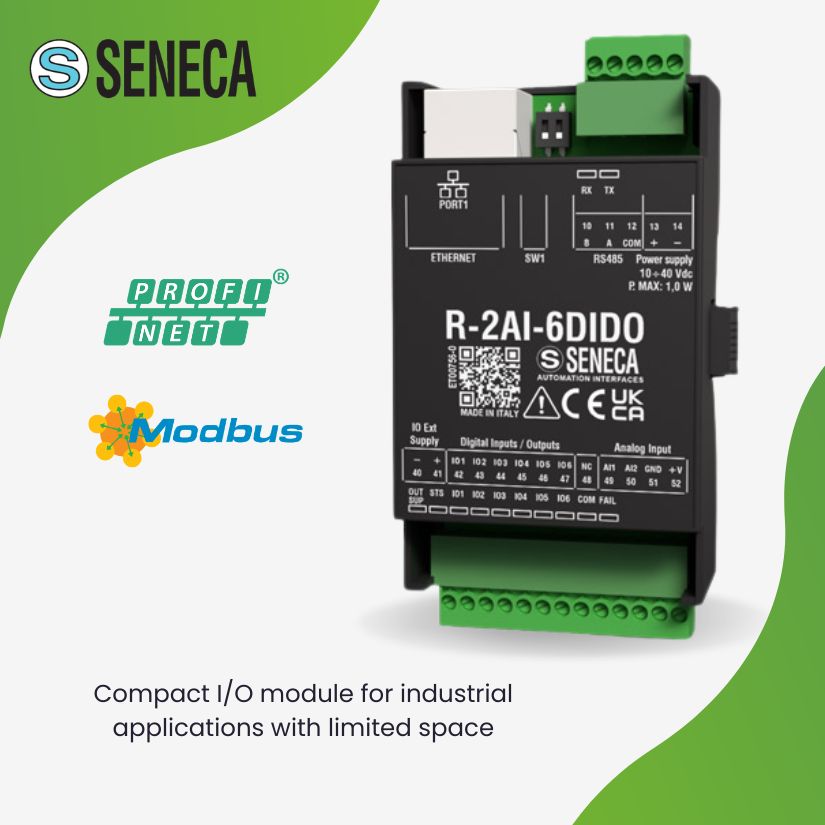
In modern industrial automation, optimizing control cabinet space has become one of the main priorities. The mixed I/O modules of the SENECA R series, R-2AI-6DIDO and R-2AI-6DIDO-P, are designed as a compact and universal solution for signal acquisition and processing in limited spaces. This overview examines the main technical advantages and application specifics of both module versions in industrial networks.
The SENECA R-2AI-6DIDO series modules combine both analog and digital channels in one housing, providing high flexibility in equipment connection. Both devices are equipped with two high-resolution analog inputs and six digital channels, which engineers can individually configure as inputs or outputs. I/O (Input/Output or inputs and outputs) modules serve as an intermediary between field sensors and the central control system, converting physical signals into digital data.
The module housing is designed with high-density installations in mind, where every millimeter counts. This configurable channel approach allows reducing the number of modules required in the system, thereby optimizing costs and physical space on the DIN rail.

The model with the suffix "-P" is intended for integration into modern Profinet architectures. The device provides fast and reliable data exchange using the integrated 10/100 Mbps Ethernet port.
System integration: The module fully supports configuration in softPLC and CODESYS environments, as well as in Siemens TIA Portal or Simatic Step7 engineering tools, using standard GSDML description files.
Fast setup: Initial parameterization can be performed directly with the DIP switches built into the housing or using the integrated HTML5 web server (web server).
Operating speed: The digital channel update time reaches up to 2 ms, providing sufficient performance in dynamic production processes.

The standard R-2AI-6DIDO model is oriented toward flexible communication in the ModBUS environment. It simultaneously supports both the ModBUS TCP-IP protocol via Ethernet and serial ModBUS RTU communication using the RS-485 port.
One of the greatest technological advantages of this module is the integrated ModBUS Passthrough function. It allows the module to operate as a gateway, forwarding incoming ModBUS TCP-IP requests from the Ethernet network directly to the RS-485 line, to which other peripheral devices are connected. For network management and quick identification in the local LAN network, the manufacturer’s free SDD (Seneca Discovery Device) tool is used, which instantly determines the device IP address, MAC address and firmware version.
To facilitate the selection of the most suitable version, the table below summarizes the most important technical specifications of both modules.
Parameter / Function | R-2AI-6DIDO (ModBUS) | R-2AI-6DIDO-P (Profinet) |
|---|---|---|
Analog inputs | 2 channels (0..30 V / 0..20 mA), 16-bit ADC | 2 channels (0..30 V / 0..20 mA), 16-bit ADC |
Digital channels | 6 configurable PNP/MOSFET channels (inputs/outputs) | |
Communication protocols | ModBUS TCP-IP, ModBUS RTU | Profinet IO (RT Class 1) |
Physical interfaces | 1x Ethernet, 1x RS-485 serial port | 1x Ethernet port (10/100 Mbps) |
Additional functions | ModBUS Pass-Through, FeRAM retentive counters | SoftPLC and TIA Portal integration |
Dimensions and mounting | 53.3 x 90 x 32.2 mm, DIN rail mounting | |
Supply voltage | 10..40 Vdc; 19..28 Vac | |
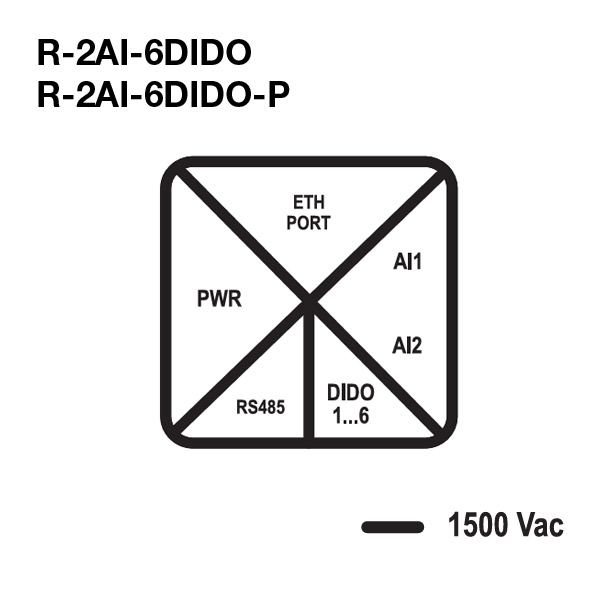
Galvanic isolation | Up to 1.5 kVac | |
Proper selection of the I/O module and alignment of the network architecture ensure stable plant data flow, preventing unexpected downtime risks and simplifying future system expansion. The solutions offered by SENECA combine industrial durability with modern ease of configuration.
If you have additional questions about SENECA R series modules or their integration, ZTF Lāsma specialists will gladly answer and provide additional consultation, and together they will be able to find the most suitable solution for the specific case or automation challenge. The company's engineering team is ready to help!