

 Facebook
 Google
 LinkedIn
https://lasma.eu/en/search/products
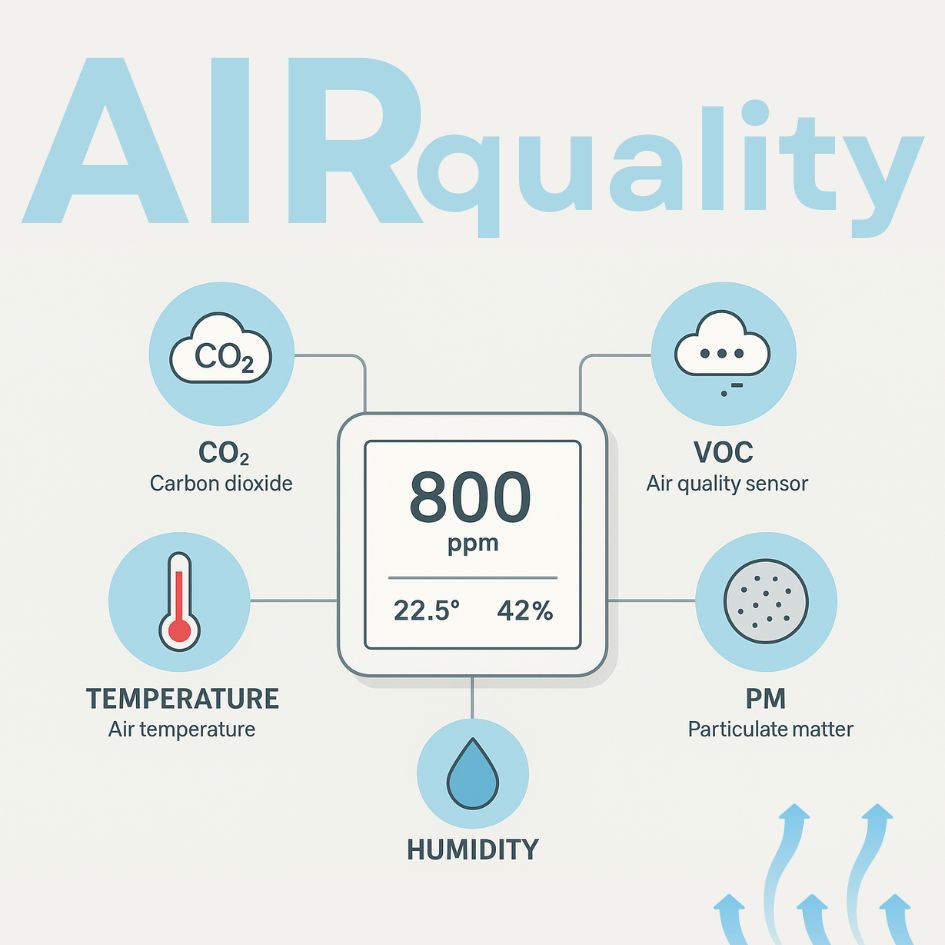
These days, air quality is becoming more and more important, because we are spending a large part of our time indoors – at home, in the office or in the classroom. Although air pollution is often associated with the outdoor environment, harmful substances can also accumulate indoors, affecting our health and well-being. That is why air quality sensors are becoming an essential tool for ensuring a safe and healthy environment.
Without objective measurements, it is difficult to understand the actual air condition, so sensors help make informed decisions about ventilation, air purification, and heating control.
Air quality sensors continuously monitor various indicators such as carbon dioxide (CO₂) levels, particulate matter (PM2.5, PM10), humidity, temperature, and sometimes even volatile organic compounds (VOC). They allow you to detect problems in time that would otherwise go unnoticed—such as CO₂ oversaturation or poorly ventilated rooms.
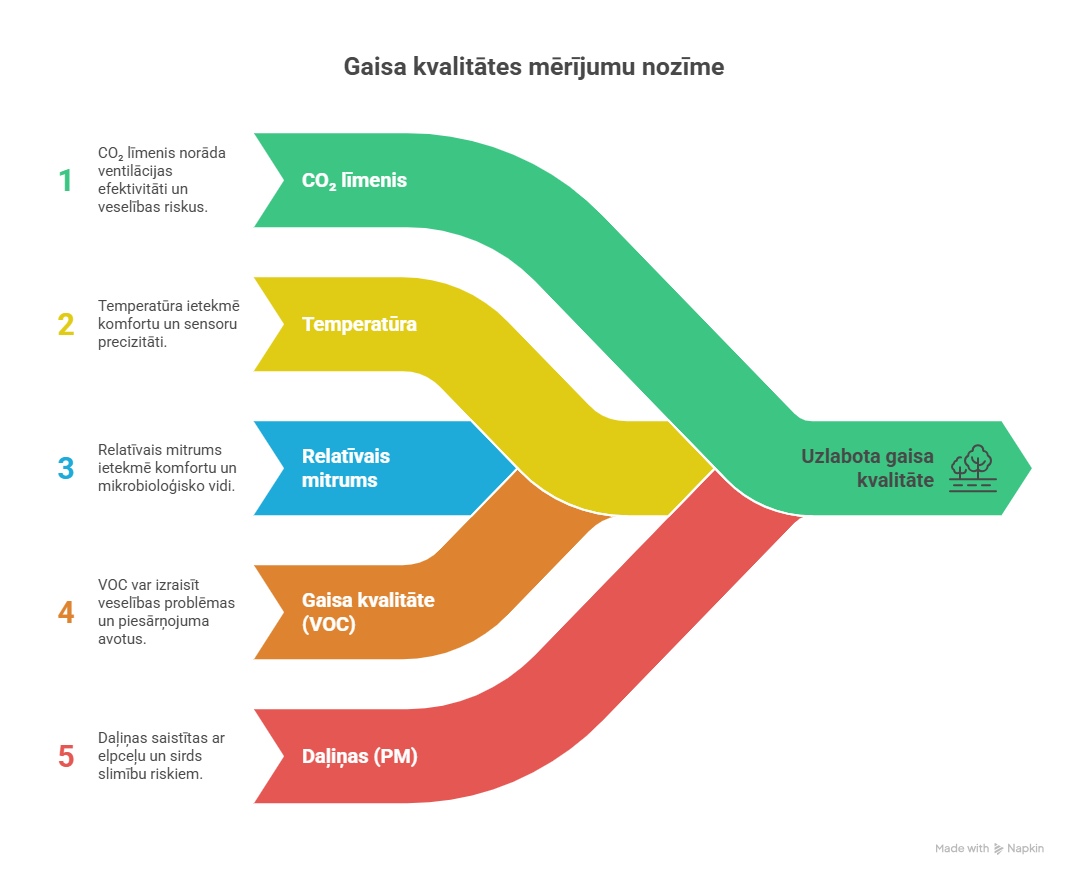
To understand what types of sensors exist and what they measure, let's look at the main measurable quantities and why it is important to determine them
CO₂ (carbon dioxide)is a natural gaseous compound exhaled by people. CO₂ levels indoors rise rapidly if there is insufficient ventilation.
Why measure it?
Temperature indicates the level of air heat in a room. Room temperature is essential for comfort but also affects the performance and accuracy of other sensors (for example, CO₂ sensor sensitivity).
Why measure it?
Relative humidity (RH %)showshow much water vapor is in the air, compared to the maximum possible amount at a given temperature. Humidity is important for both comfort and health.
Why measure it?
Air quality (VOC)Volatile Organic Compounds/Volatile organic compoundsarechemical compounds that evaporate into the air, for example:fragrances and aerosols, cleaning agents, paints and adhesives, emissions from furniture and construction materials.
Why measure it?
Particles (Particulate Matter, PM)sensors measuresolid and liquid particles in the air, within a specific size range, e.g., PM1.0, PM2.5, and PM10 (particles up to 1, 2.5, or 10 micrometers), for example:
Why measure it?
Sensor | What does it measure? | Why measure it? | Where to apply? |
CO₂ | Carbon dioxide (ppm) | Ventilation indicator, affects cognitive abilities and comfort | Schools, offices, homes, BMS |
Temperature | Air temperature (°C) | Comfort, effective heating/ventilation | In HVAC systems (ventilation, heating control) |
Humidity | Relative humidity (%) | Mold control, health, comfort | Living spaces, swimming pools, warehouses |
VOC | Chemical organic compound pollution | Odors, chemical risk, air quality indicator | Offices, homes, laboratories |
PM | Dust and particles (µg/m³) | Health risks, smog, allergies | Industrial environment, urban spaces, air purifiers |
Below, models and specifications of air quality sensors from various manufacturers are reviewed and compared
Product | Measured parameters | Measurement ranges / specifications | Supply voltage / power | Output type / communication |
E+E Elektronik CDS201 | CO₂, temperature, relative humidity | CO₂: 0–2,000 ppm or 0–5,000 ppm; humidity 0–100% RH; temperature –30…+60 °C | 15–35 V DC or 24 V AC ±20% | Analog: 0-10 V or 4-20 mA; digital: RS485 (Modbus RTU) |
E+E Elektronik HTS201 | Relative humidity, temperature | Humidity: 0–100% RH non-condensing; temperature: –30…+60 °C Humidity accuracy ±(2 + 0.003·mV)% RH; temperature ±0.25 °C (with voltage or RS485) | 15–35 V DC or 24 V AC ±20% | Analog: 0–10 V or 4–20 mA; digital: RS485 Modbus RTU. |
S+S Regeltechnik AERASGARD RFTM-LQ-CO₂-W | CO₂, VOC (air quality), temperature, relative humidity | CO₂: 0–2,000 / 0–5,000 ppm (switchable) VOC: 0–100% (various sensitivities) Temperature: –35…+80 °C (operating range –10…+60) Humidity: 0–100% RH (operating 0–95%) | 24 V AC/DC (±10%) | Outputs: 0–10 V or 4–20 mA (switchable), relay contact for setpoint |
S+S Regeltechnik AERASGARD RPS-SD (PM) | Particulate matter (PM) | PM (0.3–10 µm): model dependent, up to 500 µg/m³, e.g. RPS-SD 0–500 µg/m³ | 24 V (from instructions) | 0-10 V analog (signal) |
Aranet4 HOME CO₂ monitor sensor | CO₂, temperature, relative humidity, atmospheric pressure | CO₂: 0–9,999 ppm; accuracy ±(30 ppm + 3%) Temp: 0–50 °C (±0.3 °C) RH: 0–85% RH (±3%) Pressure: 600–1,100 hPa (±3 hPa) | 2 × AA batteries | Wireless: Bluetooth (Aranet4 HOME, device) |
Luxafor CO₂ Monitor | CO₂, temperature, relative humidity | CO₂: accuracy ±(50 ppm + 3%) (Temperature and humidity also measured) | Battery, USB charging (micro-USB) | E-paper display + visual and acoustic alerts (RGB LED) |
What are the advantages and disadvantages of each model.
Sensor | Advantages (“+”) | Disadvantages (“–”) |
E+E Elektronik CDS201 (CO₂ + T + RH) | + High accuracy and stability: dual-wavelength CO₂ measurement compensates for sensor aging. + Long-term stability and protection against contamination: RH/T sensor element is coated with a protective layer guarding against dirt. + Well-suited for integration — analog output signals (0..10V, 4..20 mA), RS-485 (Modbus), or even BACnet. + Snap-on housing for easy installation and quick replacement. | – Demanding supply voltage (15–35 V DC or 24 V AC), not battery-powered – Preferably for professional installation (BMS, ventilation control), less suitable for simple “home use” without automation. – Price: higher-end professional sensors tend to be more expensive. |
E+E Elektronik HTS201 (T + RH) | + High accuracy in humidity and temperature measurements; sensor element with protective coating against contamination. + Long-term stability and long sensor lifespan + Well-suited for HVAC systems, building automation → both analog and digital output options. + Simple installation: snap-on housing, fast replacement, protection against dirt. | – Only temperature and humidity — no CO₂ or air pollution measurements. – Demanding supply voltage (15–35 V DC or 24 V AC), not battery-powered – Preferably for professional installation (BMS, ventilation control), less suitable for simple “home use” without automation. |
S+S Regeltechnik AERASGARD (CO₂ / VOC / PM) | + Various models (CO₂, VOC, PM) allow precise sensor adaptation to needs (air quality monitoring, demand ventilation, etc.) — especially useful for contaminated or frequently used rooms. + Analog or current output mode (0..10V, 4..20 mA), integrates well with building management systems. + Robust design, suitable for professional installations in public spaces, schools, offices. | – Preferably for professional installation – experience with analog or BMS control systems required. – Limited range of simple devices — fewer portable or simple versions like home monitors. – Possible need for calibration or maintenance at a professional level. – Higher costs if multiple types of sensors are needed (CO₂ + PM + VOC). |
Aranet4 HOME | + Portable and wireless: battery-operated (2 × AA), easy to move, installable in different rooms. + Low power consumption and long battery life (depends on measurement interval). + E-ink display is highly readable and energy efficient. + Bluetooth connectivity and app for data viewing, history analysis. + Real-time alerts (color indicator + sound), if CO₂ level becomes high. + Measures not only CO₂, but also temperature, humidity, barometric pressure. | – Limited data integration: no professional Modbus / BMS connectivity like industrial sensors. – Screen/housing is not very resistant to drops or industrial environments. – Calibration may be necessary (automatic or manual) to maintain accuracy. – Time constant — the sensor’s ability to quickly detect rapid changes may be limited. |
Luxafor CO₂ Monitor | + Visual and audio alerts (RGB LED + sound signal), easily understandable (when to ventilate the room) + E-ink display + compact design — easy to place on a desk or wall. + Measures CO₂, as well as temperature and humidity — provides a more complete picture of the room microclimate. + USB charging (micro-USB) — convenient charging, no need for regular battery replacement. + Economical solution for home or office environments where a simple visual CO₂ warning is needed. | – Lower accuracy compared to professional-grade CO₂ sensors. – No industrial interface options (e.g., Modbus) — unsuitable for direct integration with building management systems. – Basic data logging — limited historical or analytics features. – Relies on the user to respond to alerts (ventilation must be done manually). |
Various examples of where and how to use air quality sensors.
Air quality sensors are a powerful tool for both building management and health monitoring. When selecting sensors, consider the following:
With proper sensor placement and analysis, you can improve the air quality in your premises, reduce risks, and simultaneously optimize ventilation costs