

 Facebook
 Google
 LinkedIn
https://lasma.eu/en/search/products
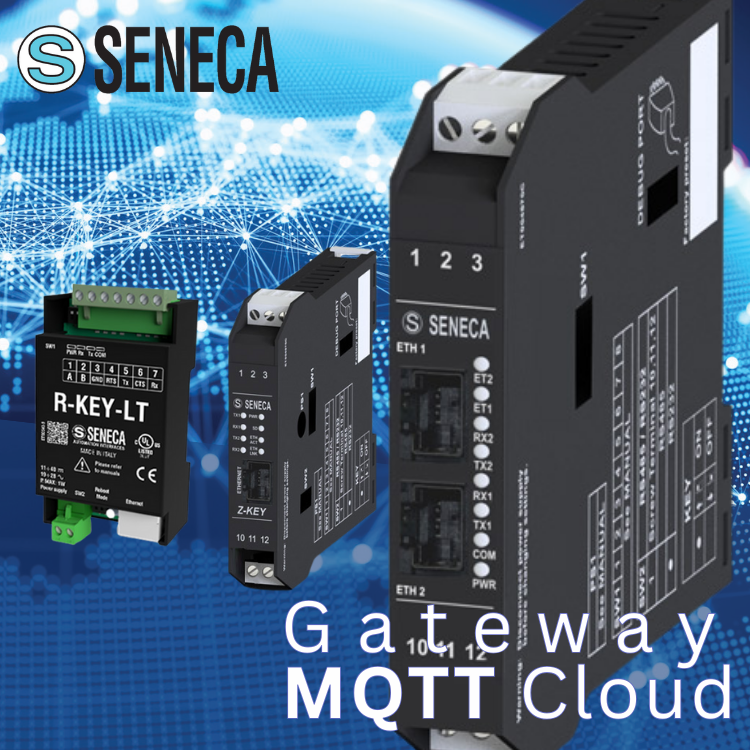
In today’s rapidly changing industrial environment, reliable and efficient device communication is more important than ever. As Industrial Internet of Things (IIoT) architectures and remote monitoring solutions become standard, reliable protocols and robust gateway solutions are essential to connect existing field equipment with modern cloud platforms. The MQTT messaging protocol—combined with the Seneca KEY-C gateway—provides secure, scalable, and future-proof connectivity between Modbus networks and cloud services.
MQTT (Message Queuing Telemetry Transport) has become a fundamental protocol in IIoT and cloud integration. Developed in 1999 by IBM engineers Andy Stanford-Clark and Arlen Nipper, it was specifically designed for resource-constrained devices operating on low bandwidth or unreliable networks. Its publish/subscribe model separates data producers from consumers, thereby ensuring high scalability, minimal network load, and reliable message delivery.
This architecture is especially valuable in industrial automation, smart energy systems, telemetry, and cloud service integration. The integrated Quality of Service (QoS) levels ensure message integrity even under challenging network conditions.
Although MQTT provides the protocol foundation for efficient data exchange, many industrial environments still operate existing devices with Modbus RTU or Modbus TCP. To implement IIoT benefits without replacing existing equipment, Seneca offers a broad range of Modbus-to-Cloud gateways, enabling seamless data aggregation and transmission from legacy equipment to cloud applications.
These gateways collect data from Modbus devices and securely transmit it via MQTT(s) or HTTP(s), enabling real-time monitoring, analytics, and control through cloud platforms.

The Seneca KEY-C gateway series is designed to suit installations of various scales—from compact setups to complex networked environments. Below are the main models:
Model | Serial Ports | Ethernet Ports | Suitable Application |
|---|---|---|---|
R-KEY-LT-C | 1 | 1 | Compact installations requiring an MQTT gateway |
Z-KEY-C | 2 | 1 | Medium-scale solutions with two serial ports |
Z-KEY-2ETH-C | 2 | 2 | Advanced systems requiring redundancy/network segmentation |
The R-KEY-LT-C model is intended for installations with limited space but requiring reliable cloud connectivity. With one serial port and one Ethernet port, it supports Modbus RTU/TCP protocols along with MQTT(s) and HTTP(s). Additional features include data logging and Seneca FLEX multi-protocol configuration support, making it ideal for small-scale IIoT solutions.
For projects demanding greater flexibility, the Z-KEY-C offers a second serial port—allowing simultaneous data collection from multiple Modbus devices. This model supports TLS 1.2 secure connections, robust built-in buffers (up to approximately 59,000 samples), and versatile deployment options suitable for mid-level automation projects.
Tailored for demanding industrial environments, the Z-KEY-2ETH-C provides two Ethernet interfaces in addition to two serial ports. This configuration supports network redundancy, segmentation, or multiple independent connections, while maintaining full MQTT/HTTP support and increased tag/variable processing capacity.

Implementing the Seneca KEY-C series provides significant benefits to manufacturers, system integrators, and automation engineers:
Seneca KEY-C gateways are designed for industrial reliability:
Parameter | Value |
|---|---|
Power Supply Voltage | 11–40 VDC; 19–28 VAC; maximum power consumption: 1W |
Operating Temperature | -25°C to +65°C (storage -30°C to +85°C) |
Humidity Tolerance | 30%–90% non-condensing |
Protection Class | IP20 |
Mounting Methods | DIN rail (35mm IEC EN60715), wall or panel mounting |
CPU | ARM 32-bit; real-time multitasking operating system |
Configuration | Web server access (username/password: admin/admin), DIP switch, or EASY SETUP software |
Connections |
|

Seneca gateways perform excellently wherever reliable integration of existing infrastructure with the cloud is needed:
By using MQTT together with the Seneca KEY-C gateway series, companies can securely connect "legacy" Modbus devices to modern cloud platforms, gaining new opportunities in analytics, remote control, and process optimization. Whether a compact solution or advanced network segmentation is required, Seneca offers a suitable gateway for your needs.
If you have additional questions about these products or need advice on the most suitable gateway for your IIoT strategy, please contact us to learn more.