

 Facebook
 Google
 LinkedIn
https://lasma.eu/en/search/products
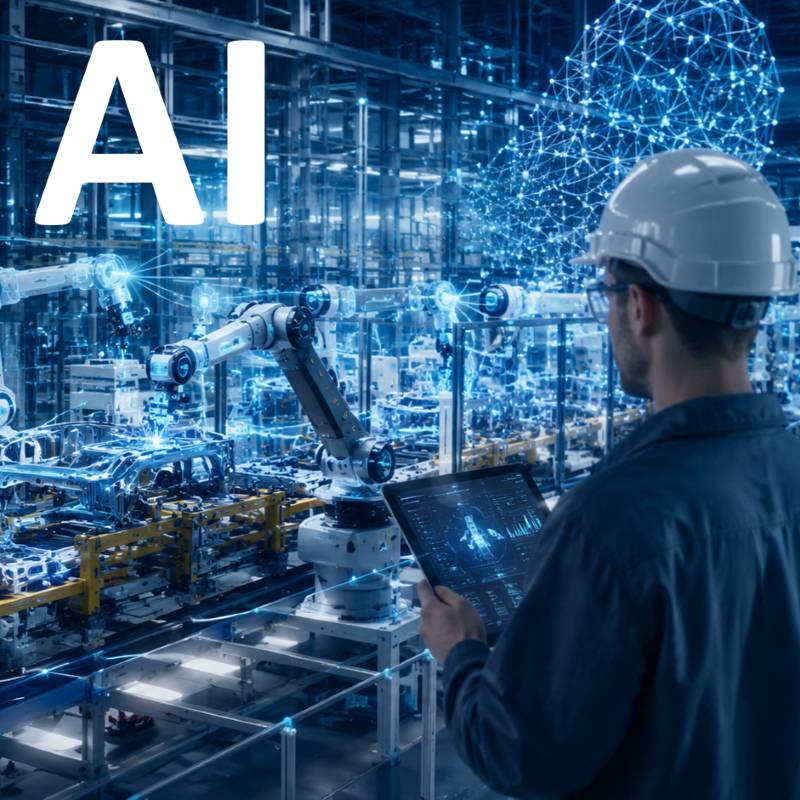
With this article, we begin a series of articles about the impact of artificial intelligence on industry, manufacturing, and everyday company processes. The goal is not to create another theoretical overview of AI, but to explain step by step where these technologies are already becoming practically usable, what value they can provide to manufacturing companies, and how to look at them pragmatically. In the future, we will occasionally publish similar articles, in which we will examine both opportunities and risks, as well as specific application scenarios in the industrial environment.
Artificial intelligence (AI) is currently being talked about everywhere, linking it to the most diverse industries and topics. In Latvian industry, AI still seems to many to be something unintelligible, distant, and a very expensive process. And that is understandable, because manufacturing companies are usually very pragmatic and do not want to pay for incomprehensible experiments. But the situation is changing. AI is no longer just a chatbot on a website or a replacement for Google — it is increasingly becoming a practical layer on top of sensors, cameras, PLCs, and production data.
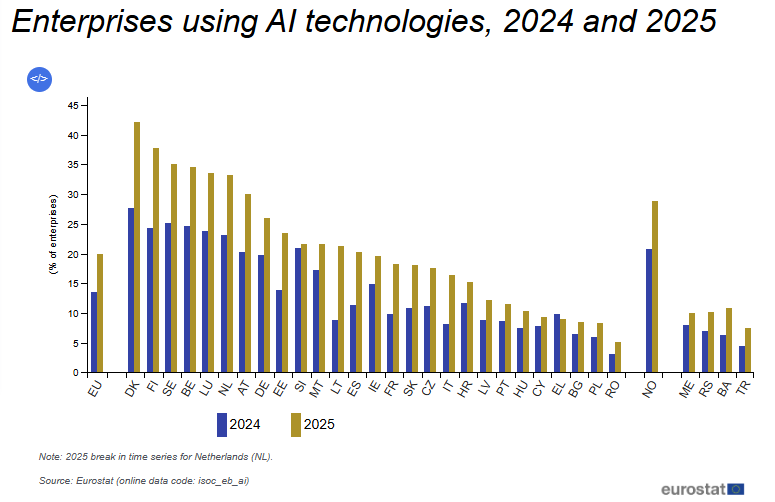
As shown by the Eurostat study on the use of artificial intelligence in business, at the EU level the use of AI in companies is growing very rapidly, and in 2025 it was already used by 20% of EU companies with at least 10 employees, compared to 13.5% in 2024.
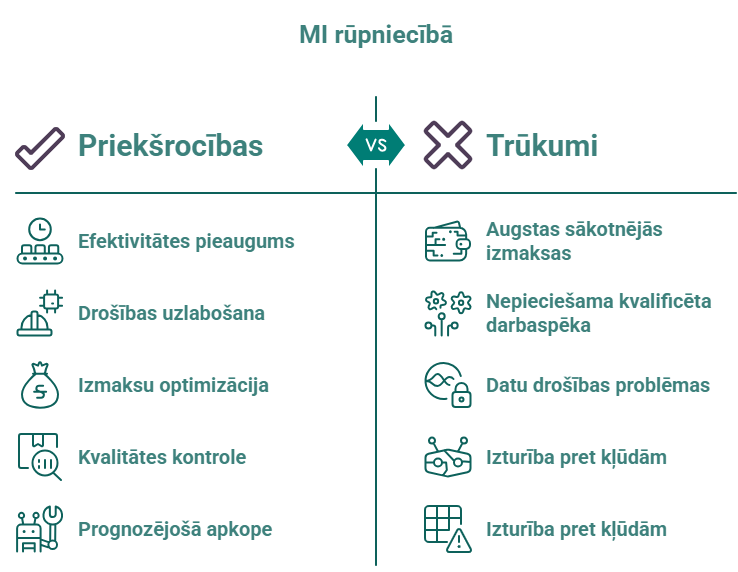
In industry, the value of AI usually does not come from “talking to the system” in the classical chatbot sense. It is the “invisible engineer” integrated directly into production processes. The value comes from the ability to process thousands of sensor data points in a fraction of a second, detecting deviations that would remain unnoticed by the human eye or traditional control systems.
Predictive maintenance: this is a transition from reactive work (“fix it when it breaks”) to proactive. AI analyzes vibrations, temperature fluctuations, or power consumption, warning of a fault before the equipment has stopped. This directly reduces expensive hours of downtime.
AI algorithms can process a huge amount of data and spot even the smallest correlations in it.
Machine vision quality control: AI can identify microscopic defects at conveyor speed that a tired worker might miss at the end of a shift. It is not only defect recognition, but also trend analysis — if defects start appearing more often, AI signals that the problem may be in the production process settings themselves. By the way, SICK already uses this in its products with SICK Nova software.
Energy and resource optimization: in industry, energy costs are huge. AI can balance loads, predict consumption peaks, and optimize cooling or heating systems based on real-time production intensity.
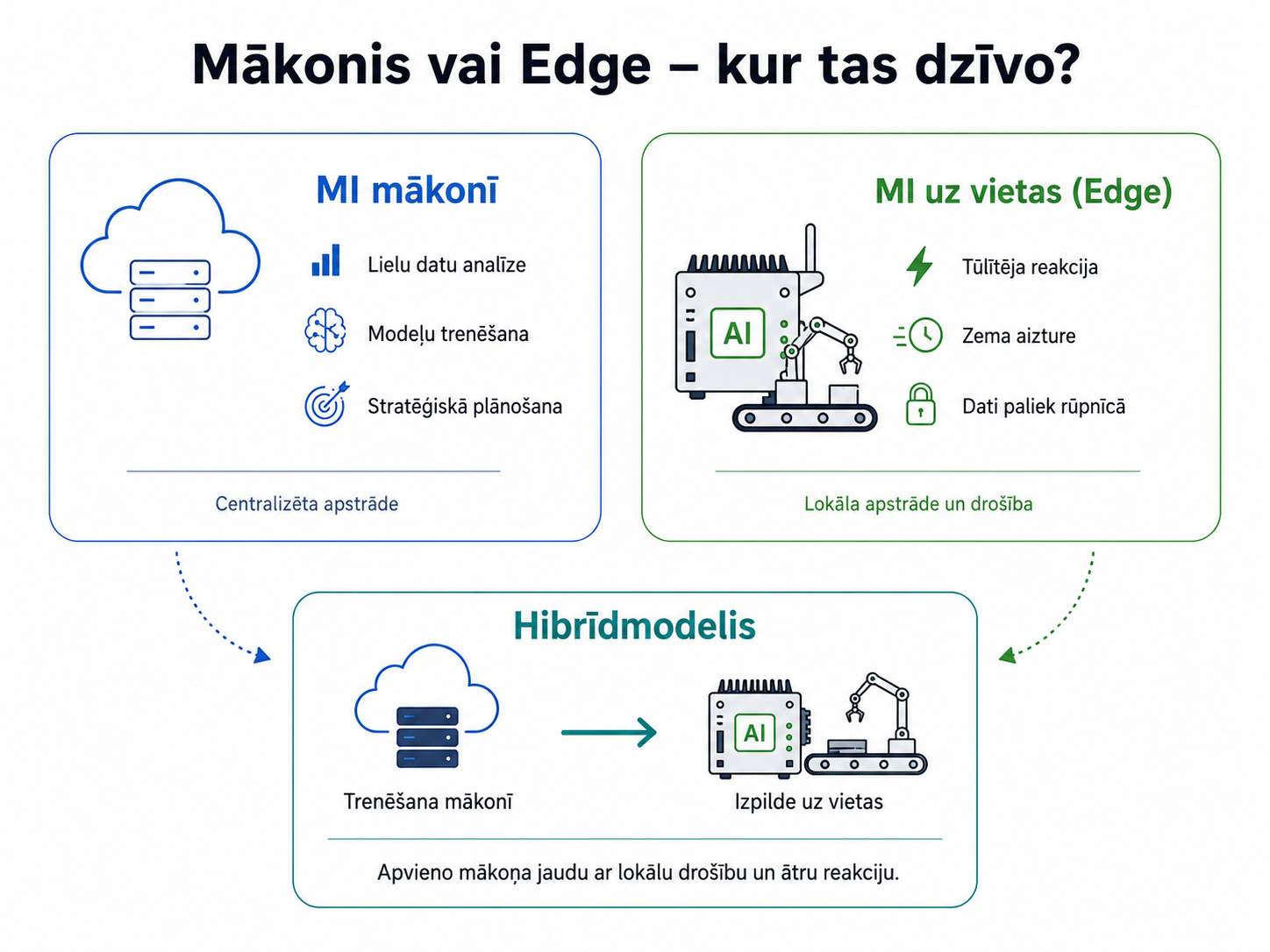
Another important thing is to understand that industrial AI is not one universal model. Its physical location determines the system's efficiency:
AI in the cloud (Cloud): usually this is where the large processes take place. In the cloud, it is easier to process huge historical data from multiple factories at once, to train complex models and perform strategic planning. The cloud is suitable for scenarios where immediate response in microseconds is not required.
AI on site (Edge): in critical processes, AI operates locally — directly at the equipment. This is very important in the OT (operational technology) environment, where response time must not be affected by internet latency. Another important nuance is that local AI solutions ensure that data does not leave the factory network, which is crucial for cybersecurity and intellectual property protection.
However, often the right approach is a hybrid model — models are trained in a powerful cloud, but executed locally on site, ensuring maximum security and immediate response in the real production environment.
It is no longer news that Siemens positions itself as one of the leaders in digital twin and industrial AI. In its official materials, the company explains that a digital twin allows products, machines, production, and even entire factories to be designed, simulated, and optimized before changes occur in the physical world. New innovations in this direction are demonstrated every year. In 2026, Siemens additionally announced Digital Twin Composer and emphasized closer integration between the digital twin, industrial AI, and real-time data.
Also SICK is not only a “camera manufacturer” in this field. SICK officially states that the company invests in Industrial AI and that its Inspector series cameras already include deep learning and AI functions, including the ability to run certain AI inspections directly on the camera. SICK also explains that such cameras are suitable for more complex quality tasks where classical rule-based machine vision is no longer sufficient — for example, in food, packaging, wood, or metal surface inspection.
Meanwhile, Schneider Electric is actively developing the use of AI and data in energy management and digital infrastructure. In the company's official resources, AI is positioned as an essential tool for efficiency and detail. In 2026, Schneider publicly continued to develop the AI topic both in infrastructure and energy solutions. In the industrial environment, this is very important, because for some companies the value of AI will be seen precisely in energy, power supply, and resource management, not in “big autonomy.”
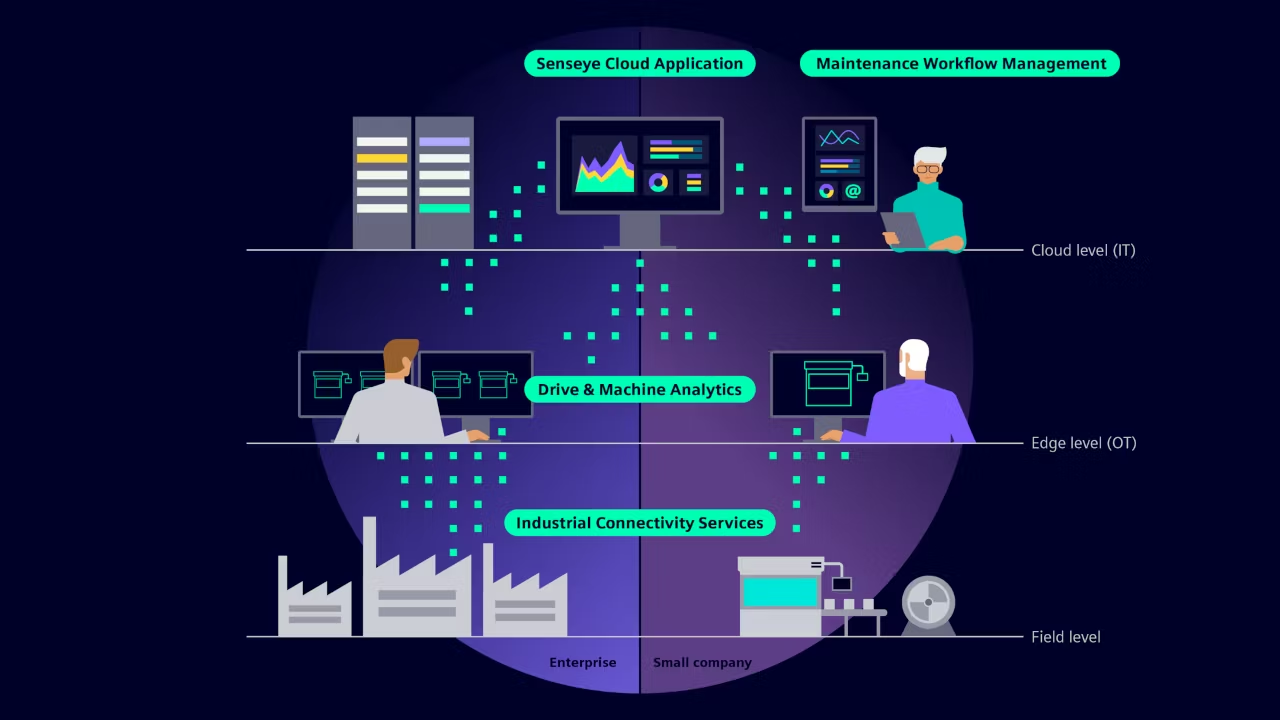
AI is already transforming manufacturing, making it more efficient, safer, and more cost-optimized, thanks to real-time data analysis and machine learning models. In practice, this means not only automation, but also predictive decision-making, which reduces errors and downtime by tens of percent, for example by using SICK AI cameras for defect recognition or Siemens Senseye for predictive maintenance.
Application | What it looks like in practice | Where it is especially logical | Example and benefit (with manufacturer) |
|---|---|---|---|
Quality control with AI cameras | The camera recognizes defects, labeling errors, surface deviations, or incorrect assembly | Food, packaging, pharmaceuticals, wood processing | SICK Inspector83x performs fast AI defect detection at up to 15 inspections/sec., for example in food and packaging production, reducing errors without specialists. |
Predictive maintenance | AI analyzes vibration, temperature, current, or pressure and notices deviations before failure | Motors, pumps, fans, compressors | Siemens Senseye analyzes machine data, such as vibration and temperature, reducing maintenance costs by 40% and downtime by 50%. |
Energy and resource optimization | AI looks for inefficiencies and helps regulate processes according to load or conditions | Cooling, heat exchange processes, compressed air | Schneider Electric AI Eco Mode optimizes HVAC cooling, saving up to 15% energy in building control and industrial processes. |
Digital twin and simulation | Before changes, it is possible to simulate the production flow, node behavior, or line configuration | New lines, modernization, pharmaceuticals, mechanical engineering | Siemens or Phoenix Contact digital twin maps sensors and actuators in process automation; Weintek Weinbot AI supports HMI simulations in modernization. |
In pharmaceuticals, this topic is especially understandable. There are high requirements for quality, traceability, documentation, and process stability. In such an environment, AI can help on several levels:
a camera can inspect packaging, labels, or blister quality,
a model can notice process deviations earlier,
a digital twin can help evaluate changes in the line before they are introduced into real production.
In such an industry, the argument for a local model and local infrastructure will often also be understandable, because not everything should or may be sent to an external cloud. This is a good example that AI architecture is not a matter of ideology — it is a matter of application choice.
AI architecture is not a matter of ideology — it is a matter of application choice
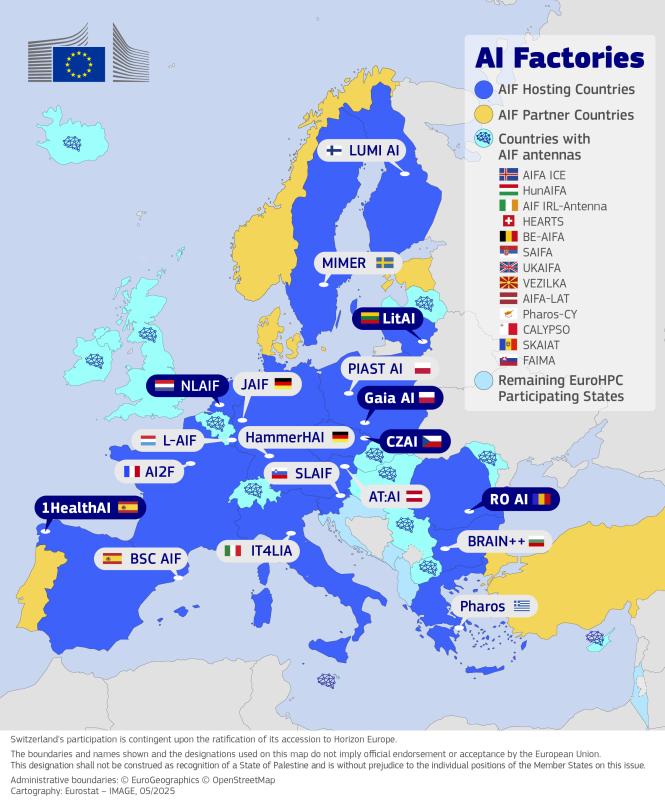
Although this transition in Latvia is not yet uniform, that does not mean it is not happening or that it is impossible. The European Commission states that the digital intensity of Latvian SMEs still lags behind the EU average, but at the same time the EU is actively building AI infrastructure and implementation support, including AI Factories, Apply AI Strategy, and a broader Digital Europe support ecosystem. This means that tools, competencies, and implementation paths are becoming more accessible to companies.
In Latvia and the Baltics, for many companies AI still seems “too big.” Often there is a lack of well-structured data, a unified OT and IT logic, or simply confidence that it will pay off. This skeptical background is real. However, the situation is gradually changing.
AI is no longer an impossible or exotic process. The EU has already deployed 19 AI Factories, is developing the AI Gigafactories initiative, and is advancing the Apply AI Strategy, which is directly intended for AI implementation in strategic sectors and the SME segment. Referring to the European Commission report, in the coming years AI implementation in European industry will become more structured, more accessible, and less “only for the big ones.”
It goes without saying that ZTF Lāsma is not only component sales. Our vision and goal is to help Latvian and Baltic manufacturers develop in automation, increasing regional competitiveness with practical solutions. With more than 30 years of experience in sensors, automation architecture, and processes, we understand what is worth digitalizing first and whether it is worth doing at all.
In practice, this means helping the client answer three main questions: where there is one clear problem, what data is already available, and whether a cloud solution or a local edge model will be better for this case.
A good start is never “the AI strategy of the whole company,” but one specific pilot project: one critical machine, one quality check, one energy anomaly area, or one problem line. It is exactly in this approach that ZTF Lāsma can connect ready-made technologies with real application and prepare the client for changes in the coming years without unnecessary hype.
AI in industry is no longer “sometime in the future.” Siemens digital twins, SICK AI cameras, and Schneider efficiency solutions are already working — somewhere in the cloud, somewhere locally. In Latvia this means lower maintenance costs and faster production with EU fund support, rather than huge investments.
Although in Latvia this may still seem distant, it is no longer an unrealistic or inaccessible process.
With ready-made manufacturer solutions and pilot projects, AI is a completely real next step in our industry as well.

AI Factories | European Commission | Last update 23 April 2026
AI Continent Action Plan delivers major milestones | European Commission | 09 April 2026
Senseye Predictive Maintenance | Siemens
Use of artificial intelligence in enterprises | Eurostat | Data extracted December 2025
Outperform your competition with a digital twin | Siemens