

 Facebook
 Google
 LinkedIn
https://lasma.eu/en/search/products

SOU-13/1 together with the SKS-200 photosensor combines a twilight switch, daily, weekly, and annual time programs, ASTRO function, and Wi-Fi setup in a single 2-module DIN device, providing lighting control based on both actual light levels and schedule. It is suitable for outdoor and industrial environments where precise, remotely configurable, and reliable operation is required, such as in parking lots, facade, and area lighting.
SOU-13/1 is a digital twilight and lighting switch that operates with the external SKS-200 photosensor. Simply put, it measures the ambient light level and switches the output according to the set threshold and active time program.
Practically important is that the twilight switch function is subordinate to the time programs. This means that the device can be set to respond to darkness only during certain times, days, or seasonal periods, rather than constantly following the lux level.
The device combines several control modes in one solution:
Control by light level with the external SKS-200 sensor
Daily, weekly, and annual time programs
ASTRO program by coordinates or one of over 500 pre-set cities
Pulse or cycle mode for specific control logic
Due to this combination, SOU-13/1 is more suitable than a simple photo relay for applications where lighting must follow both the actual daylight level and the operational policy of the site.
The product combines several features useful both during implementation and daily operation:
Built-in web server and Wi-Fi (2.4 GHz) — setup and control can be done via a browser without additional software.
NTP time synchronization — the internal clock can be synchronized via an NTP server if the device has internet access.
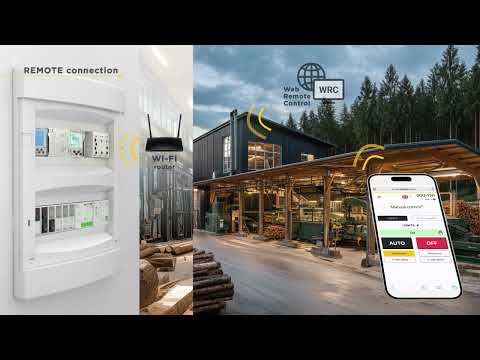
WRC remote access — web remote control and setup from anywhere are available if the switch has internet access.
User-replaceable backup battery — CR2032 battery maintains the set time during power outages.
Operating hours counter — useful for maintenance planning and basic operation time tracking.
PIN code protection — helps prevent unauthorized parameter changes.
Wireless firmware update — simplifies updates without needing to open the panel for maintenance.
The display also provides practical status information, including output state, Wi-Fi connection, battery status, time data, and sunrise or sunset indicators. This facilitates on-site diagnostics for both electricians and maintenance personnel.
Before selection, check the main electrical and functional parameters against the specific installation.
| Technical Parameter | Value |
|---|---|
| Supply Voltage | AC 100–240 V (50–60 Hz), DC 145–335 V |
| Programs | Daily, weekly, annual, and astronomical + light control |
| Replaceable Battery | Yes |
| Sensor | External, SKS-200 |
| Adjustable Light Level | 1–50,000 lx |
| Wireless Communication | Wi-Fi (2.4 GHz) |
| Output | 1 × changeover contact, 10 A (AgSnO2) |
| Housing | 2-module design |
| Dimensions | 90 × 35 × 64 mm |
The wide power range and adjustable lux range make the device flexible for various lighting control panels, but the final choice should be based on the actual load and installation environment.
SOU-13/1 + SKS-200 is a good solution in places where lighting should not be controlled solely by time or lux level.
Typical examples include:
Parking lots and driveways
Building facades and architectural outdoor lighting
Industrial yard lighting
Pedestrian pathways and shared outdoor spaces
Sites where seasonal schedule changes need to be made without frequent site visits
Practical example: A site may require lighting to turn on only when it gets dark, but not earlier than a specific evening time, and to turn off earlier during a night break period. In such cases, a combined twilight switch with time programs is more useful than a simple photo relay.
Before selecting or implementing the device, check these points:
Supply voltage and load type — ensure that the panel's power supply and output parameters match the controlled circuit or intermediate relay.
Sensor placement — SKS-200 should measure a representative ambient light level, not the direct light of the controlled luminaires.
Internet availability — NTP synchronization and WRC remote access require an internet connection for the switch itself.
Local network availability — a permanent connection to the local network may facilitate maintenance access.
Protection against environmental influences — the sensor is IP65, while the device front is IP40 and terminals are IP20, so the panel design still matters.
Programming scope — assess whether daily, weekly, annual, holiday, and ASTRO programs are truly needed, as this is where the device offers the greatest benefit.
Battery maintenance — the backup battery is replaceable, so it should be included in the maintenance plan.
One of the most common mistakes is placing the sensor where it is directly illuminated by the controlled luminaires. This can cause unstable switching. The correct approach is to mount the sensor where it sees the actual ambient light level of the site.
SOU-13/1 + SKS-200 is a flexible lighting control solution for installations where control by ambient light level, time schedules, and remote configuration are needed in one device. It helps reduce unnecessary operating time and facilitates future adjustments.